Tuesday, November 29, 2005

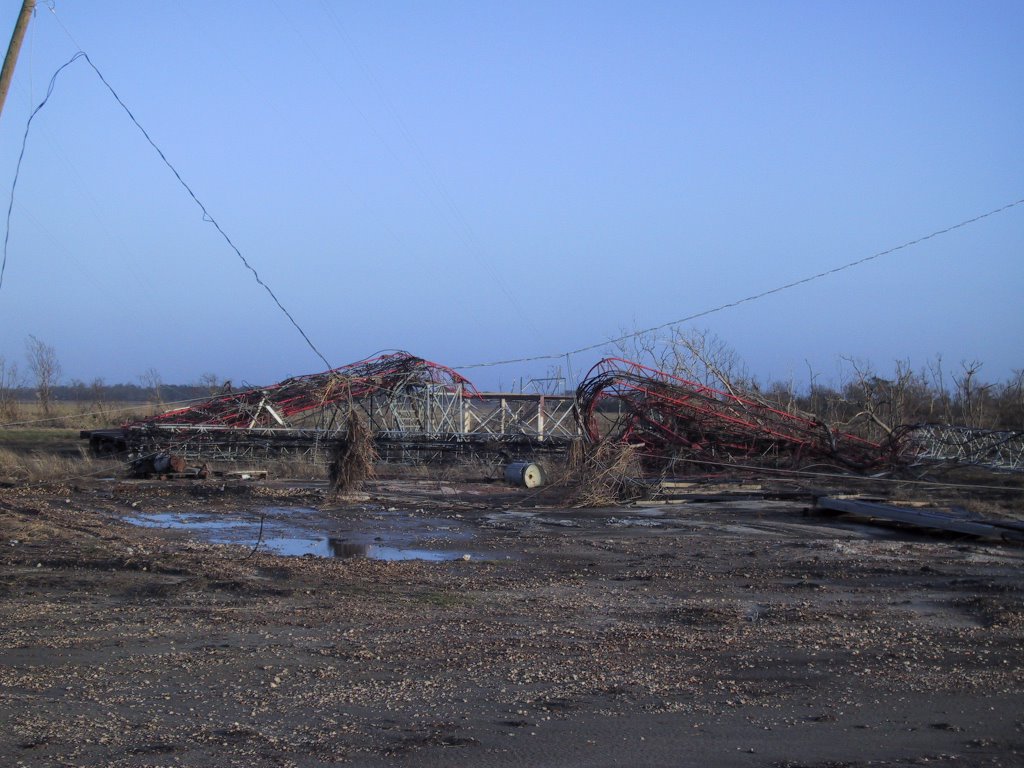
And this one was lying in a twisted heap on the ground. Needless to say, we won't be using any of these three towers.

The visit to Cameron was emotionally difficult. More later.
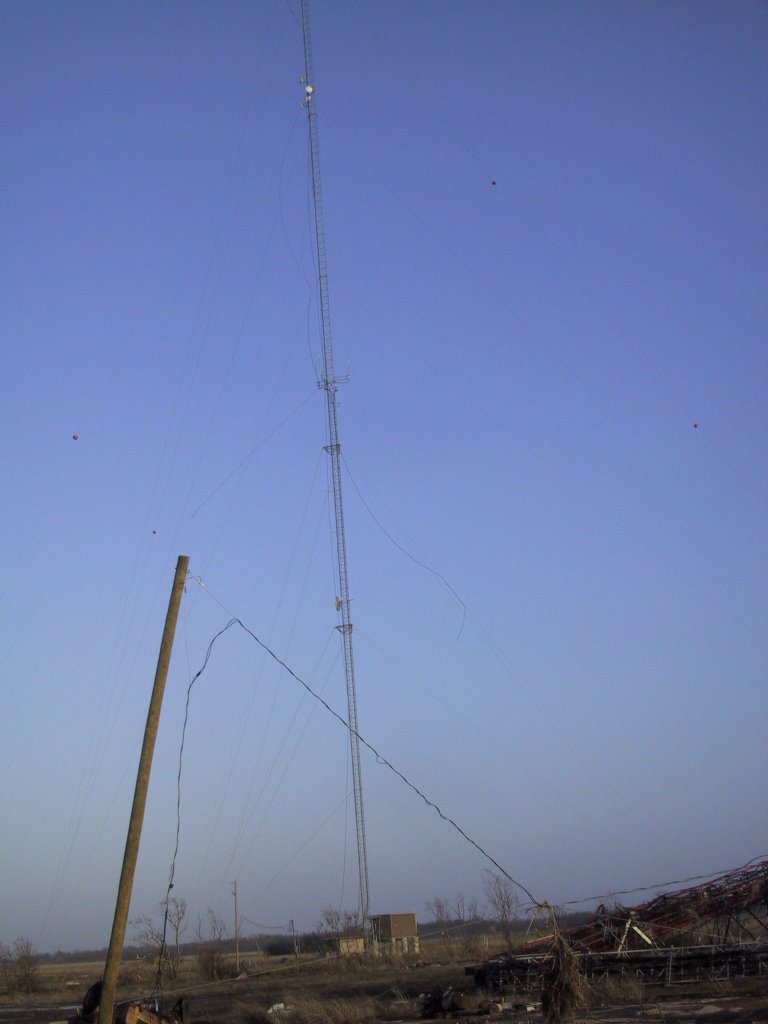
This one had the top snapped and dangling.

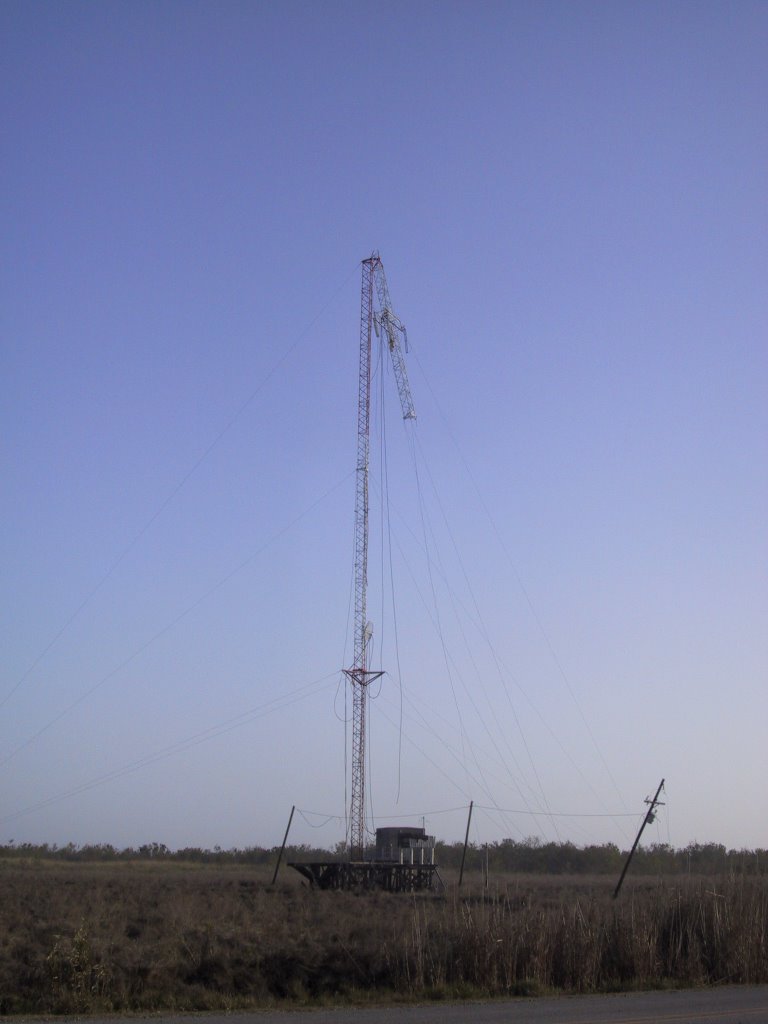
Cameron Parish

On Sunday, we took a field trip to Cameron Parish in the far southwest corner of Louisiana. We may be installing a radio antenna there soon and we were given the locations of three towers to investigate. This first one had several snapped guy wires, making it unsafe to climb.


Thursday, November 24, 2005

Happy Thanksgiving

Today we have a much-needed day off. As we relax here, comfortable and well-fed in Odyssey, we are trying to keep it all in perspective -- so many around us here have so little, and we have so much. We do, indeed, give thanks for our many blessings.

We have been so busy, of late, that we have not even had time to make plans for our dinner this evening. We have a nice T-bone steak in the fridge, or we may try to find a nice restaurant here in Baton Rouge that is open. Perhaps even one of the casinos along the river, which most assuredly are.

We have no need of the traditional turkey dinner, as the Red Cross put on a spectacular spread last night at headquarters for all the volunteers. In addition to turkey with all the trimmings, there was some kind of beef roast, sliced ham, and some type of cajun jambalaya dish. It was all quite tasty, and there was a familial holiday feel to eating together at HQ. Since we have also been eating out almost nightly with coworkers, we are planning to have a quiet dinner alone tonight.

We did make an effort to find someplace we could volunteer to help serve dinner tonight, but southern Louisiana is crawling with volunteers, and very few people are still in shelters or in need of food, other than those being served by the Red Cross canteen routes. Apropos of that, the one millionth meal prepared by the Southern Baptists at the Red Cross kitchen in Kenner neatly coincides with Thanksgiving dinner, and Good Morning America this morning has been (I am told) covering the event. I should hasten to point out that this is the millionth meal from this one kitchen -- the total count of meals served in Louisiana by the Red Cross is posted daily at HQ, and the number was around 12 million the last time I looked.

It has been quite a while since I have posted here. Careful readers will have noticed that 13 of the last 14 entries were posted by Louise, who normally eschews posting large blocks of text here. For some reason, she has been much more motivated than I while we have been parked here at HQ, whereas I am usually more motivated when we are under way. I am sure there is some deep psychological insight that can be derived from that, which I will leave, as they say, as an exercise to the reader.

Since Louise has been doing an excellent job of keeping you all apprised of our daily lives as Red Cross volunteers, I will, instead, take a few moments to answer a question recently posed by one of our readers. This fellow RVer wants us to describe the rhythm of Odyssey's various systems, now that we have some real-world experience.

As it turns out, there are two distinct modes of daily life aboard Odyssey, one which I will call "under way" and one which I will call "parked," for lack of a better term. Under way includes moving from point A to point Z , camping along the way at any number of intermediate points for up to three or four nights, whether in campgrounds or "boondocking" in parking lots or on undeveloped land. Parked means camped in one location for some longer period of time, which, for us, usually means dry camping. It is only recently that we have come to fully understand this second mode, parked here, as we have now been, for nearly seven weeks straight.

While under way, we tend to carry about half a tank of fresh water. That gives us the ability to boondock for a few nights without worries, yet avoid the fuel burden of carrying a full tank weighing 1,125 pounds. We also tend to dump our waste tanks whenever we pass a free dump if they are at least 1/4 full, and we try hard not to let them go over about 2/3 full for reasons of both weight and flexibility to boondock for a few nights at any stop. In practice, these two policies mean that we dump and fill every five to seven days

Under way, we shower in the evening. We get plenty of "free" hot water made with waste heat from the main engine, and it is still hot enough for showering by bed time. In the morning, only luke-warm water remains, suitable only for hand washing. The main engine alternator also fully charges the house batteries while under way, and so we never run the generator except in the very rare circumstance that we need to run the air conditioning while camped.

Heat or A/C are similarly plentiful when under way, and only rarely do we need to fire up the diesel boiler, typically only for an hour or so in the chill of the morning in cold climates.

In contrast, when we are parked, we fill the fresh water tank to the very brim. By being conservative with showers and other water usage, we can easily go for two full weeks on one tank of water. We are in our seventh week here, and we have only filled (and dumped) three times.

With no access to commercial electricity (and, as yet, no solar panels on Odyssey), we have been averaging about two hours per day of generator run time to keep the batteries charged. This is exactly the amount of daily generator run-time we had anticipated for long-term boondocking when we designed the systems. Since the battery charger uses only a fraction of the generator output, we time the generator runs to get heat, A/C, or hot water as needed. When the climate is warm, we run the genny in the afternoon for A/C, and shower in the evening with the "free" hot water. When the climate is cool, as it is here now, we run the genny in the morning to produce both heat and hot water, and shower in the morning. The charger runs at full output each time, and the batteries stay in the 40%-80% range. Today we are charging them to 100% for the first time since our arrival, just to keep their life cycle up.

Some systems are unaffected by our parked versus under way status. We go through our two tanks (totaling less than five gallons) of propane every four months or so -- we have filled them four times since we left last August. Our 45 gallon drinking water tank will easily last three months, and we never let it go that long. I empty, purify, and refill it about every six weeks or so. The fridge holds two weeks of food, and we also need to find a laundromat every two weeks. We buy diesel based on what state we are in and whether prices are rising or falling.

So there you have it -- Odyssey's bodily needs (in a manner of speaking) in a nutshell. I hope that answers the question, and I wish all of our readers a joyous, safe, and comfortable Thanksgiving.
Monday, November 21, 2005

Sunday, November 20, 2005

RTT: Nerd Paradise

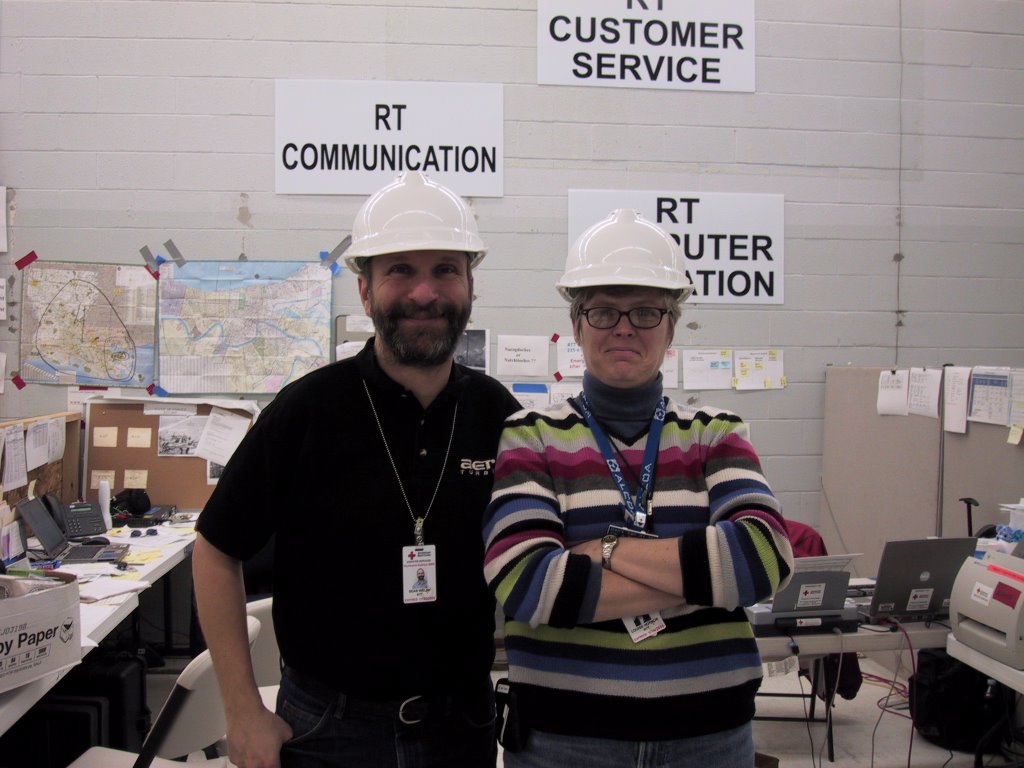
Our departments here at the Red Cross fall under a grouping called RTT (Response Technology Team). RTT consists of five areas: Communications, Field Support, Customer Service, Computer Operations, and Networking. Sean is currently supervising the last two, and I am supervising the first two. It's a great group of jovial engineers, sharing a desire to help others. It's our guilty little secret that the disaster actually allows us to do some really cool stuff with radios and satellite uplinks. Because HQ is in constant flux, we rearrange the network, rewire phone lines, string cables through the ceiling and crawl under desks. Today Sean drove the scissor lift.

I think the best part is being recognized as the Uber Geeks in a non-technical setting. Most engineers work for an engineering company. They are surrounded by other technology-savvy people. Here, we support primarily the non-savvy. We get to go out and fix things that baffle the other office workers and yet are quite simple for us. Computers, printers, walkie-talkies and software are a mysterious and unnatural necessary evil in their work day, and when those things do anything out of the ordinary, we make it all better. Our customers are always so grateful! Not a day goes by that I am not thanked for my help. "Oh, RTT is here! They will save the day!" Of course, we're all volunteers here and being thanked is the great reward for all of us. So, I try to thank my customers in turn for the work they do. Some of their jobs would be overwhelming to me, and I am so glad they do that work instead of me. I'd much rather install 50 phones lines and run hundreds of cables than sit down and make calls at those phones all day. Fix your printer? Sure, no problem! Enter all that data that you're printing? No thanks!

This really is nerd paradise. At the end of the day, for most of us in RTT, there are no reports to write. Since the time on the job is short, typically 3 weeks, no one is expected to be an expert and it is always okay to ask for help or training. It's difficult to be here long enough to become territorial, which leads to some great camaraderie. Our performance reviews don't affect our pay scale one iota. The Red Cross supplies an unending stream of snack foods, free for the taking, in the break room called The Oasis. Field trips are a regular part of the job, so most of us are not stuck in the office every day. And the end product is helping people put their lives back together, not some meaningless widget. Does it get any better than this?

Thursday, November 10, 2005

We are everywhere


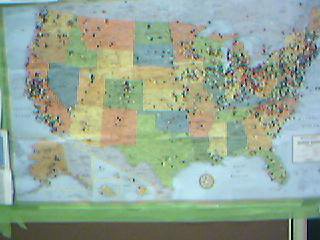
This blurry picture is of a map near my desk. It shows, with small stickers, the hometowns of the volunteers on this Red Cross Disaster Relief. Off to the side and not visible in the photo are maps of Africa, Europe, South America and the rest of North America, also with many stickers. The map amazes me; literally thousands of people have given on average three weeks of their time to be here. Many left behind spouse and children to sleep on a cot in a shelter, take showers in large tents, work 10 hours days and get up to do it again.

By contrast, our deployment seems like a cake walk. Traveling is what we do, so getting here was a normal part of our routine. We sleep in our own bed, rest comfortably in our own easy chairs, pet our animals, and eat our regular diet. The 10 hour days are tiring, though, especially after not having regular jobs for over a year. By the time we cook and eat dinner, do a few errands like laundry or grocery shopping or dumping the tanks, or have a much needed social evening with our coworkers, there isn't much time or energy left for blogging!

I know our families have been checking in for updated info here; sorry for the long delays between posts. There really isn't much new to report. We're still in the Lowe's parking lot, the weather has turned autumnal. In Louisiana, that means cold, foggy, drippingly damp mornings and warm, sunny afternoons. Our towels don't really dry out between showers. On the work front, we are both considered "old timers" now and train the newcomers. I enjoy that; its fun to play the part of expert. About once a week, I get to go on a field trip to a location outside Baton Rouge. This week I went to Lake Charles, which is a two hour trip. There is a shelter there in the Civic Center which has been having many technical issues. We've installed and re-installed phones, fixed fax machines, retrieved wayward computers, and tried to be as helpful as possible while offering support from so far away.

We also drove a big loop around Lake Pontchartrain on our day off, to get a better look at the area in the daylight. All I can say is that the photos you saw on the news in the last few months do not capture the devastation and the despair. There remains years of rebuilding ahead, with each cracked open house with its spilling, sodden, smelly contents representing an unimaginable heartache for some family. The news media has moved on to new items, but this damage is still here. It is less than 1% fixed.

If you want to join us on that map in the photo, you can. You can volunteer, or you can do something that many of the volunteers can't afford. You can donate to the Red Cross, or another charity that is helping. Or, at the very least, remember that we are all vulnerable to forces larger than ourselves, so be kind and loving to another. Its the least we can do.

Wednesday, November 2, 2005

Beer and Pizza

Last night we had a party for all our coworkers in the RTT department. About 12 people came over and enjoyed pizza and a tour of the bus. It is always fun to give tours to fellow engineers; they truly appreciate some of the finer technical points of the conversion. At least three of our guests, including our department manager, are also RVers.

It's been a while since we've had a real party; you know, the kind where you know everyone's name. At the end, there were six of us sitting around our newly initiated Campfire in a Can, drinking beer, swapping lies and laughing.

In other news, Sean has been promoted and I have been demoted. Sean is now the supervisor of the Response Computer department (RCO) and my supervisor is back from her time off. It was interesting to do her work for a few days, and I am just as happy to be back at the cell phone desk. I'm also spending more time in the warehouse, which is a great way to learn more about all the different equipment.

We have also both completed the two-hour Introduction to the ECRV class. ECRV stands for Emergency Communications Response Vehicle, a Ford Excursion bristling with a generator, radios, cameras and a satellite uplink. Hmmm, sounds a lot like Odyssey, but much more cramped. The closest of the 12 Red Cross ECRVs is currently about an hour's drive from here, so it was a pleasant field trip out into the countryside. The full ECRV training is a 40 hour class which is rarely offered and by invitation only. We're looking to get on the list for that and perhaps take it in Austin this spring. Also required is the RC driver safety course, which we can probably complete here in Baton Rouge.