Well, I'm about to spend my third night in this spot. So far, no one has even given us a second glance, except for one of the Lowe's forklift drivers, who allowed that he wanted to retire in a bus himself some day. I have been in Lowe's daily for parts of one kind or another. Unfortunately, they did not have what I needed today -- a Grabber cabinet latch. The Grabber on the big kitchen utensil drawer exploded today.
Actually, I have averaged only a couple hours of bus projects a day. The rest of my time has been spent catching up on organizing things, and studying for my amateur radio license. Now amateur radio is something that I have studiously avoided my entire life, and I had intended to keep it that way, but it apparently comes in handy from time to time on Red Cross disaster operations. As I posted here earlier, we are going to become certified operators of the Emergency Communications Response Vehicles. These trucks have fourteen radio transceivers in them, and twelve of them require an amateur license to operate (the other two are a CB and a Red Cross licensed frequency). We've been repeatedly told that holding an amateur license is not a requirement to be an ECRV operator, but that "it comes in handy."
So I find myself refreshing my memory on basic RF and electronics, and boning up on a lot of mundane minutiae about FCC regulations pertaining to the amateur service. The reason I am doing this right at this moment is that there will be an (optional) amateur license exam administered during our training class next week. The book I have on the subject helpfully suggests that I can learn the material in "only 20 days." I started yesterday evening, and the test is next Thursday. The Red Cross, helpfully, is allowing us two one-hour study sessions. So I thought I had best get the preliminary reading done now. So far, I have been averaging about 91% on the various on-line practice tests available on the 'net, so I think I am in pretty good shape.
With all the reading and staring at the computer screen all day long, I have not really gotten out of the house much since I parked here. So tonight, Opal and I took a long walk around the complex. I discovered that my restaurant list was short -- there is also a Chipotle Grill, a Logan's, a Quizno's, and a Romano's Macaroni Grill within a short walk. (I'm finally out of leftovers, so perhaps tomorrow I will treat myself.) A US Post Office is on the next block, and there are two banks across the street. A city bus runs right past us. To top it all off, the complex of buildings I am behind contains a dentist, an optometrist, and a SuperCuts -- what else could a body need?
So far, it has been peaceful and quiet here as well, though, tonight, there is a tractor-trailer idling 15 yards from me. He's been idling there for two hours or so now, presumably to keep his A/C running -- even though it is only 65 degrees outside. What a colossal waste of diesel... clearly a company driver, not an owner/operator.
Friday, March 31, 2006

Wednesday, March 29, 2006
Drying out behind Lowe's
I am in the parking lot behind a small strip shopping center, adjacent to Lowe's (map). Normally, I would prefer to park in Lowe's parking area, so that I could secure specific permission from the store. However, the only lot is in the front of the store, and it's a bit exposed (the area behind the Lowe's is a loading zone).
Fortunately, Lowe's shares this parcel with a small strip mall, and its shallower depth leaves plenty of parking in back, which is mostly unused. The area that I am in also happens to be behind a vacant store. The down side of this sort of situation is that, as a general-use complex, there is no specific tenant from whom to secure parking permission. The flip side of that coin, though, is that none of the tenants is in enough control of the premises to make an issue of it, absent any security service acting on behalf of the landlord (I haven't seen any).
This is a great location, for several reasons. First, of course, is that Lowe's is close at hand -- I've been in there several times already picking up project parts. Second is that there is an Albertson's grocery store in the complex, and I've already been in there for supplies. Third is that the rear lot is discreet, quiet, and unseen from the street or from the main parking areas -- I have had minimal looky-loos driving by. The back fence overlooks a creek, so there are no businesses immediately behind me. And lastly, should I tire of plowing through the pile of leftovers I have in the fridge, there are several restaurant options within half a block, including a Texas Land and Cattle steakhouse, a Chili's, a Rockfish Grill, a Texadelphia, and even a sushi place and a Krispy-Kreme. And, of course, Albertson's, which has hot cooked items in the service deli.
When I took Louise to the airport, it was pouring rain, as it had been for several hours and continued to be for several hours more. I learned today that Austin received a record amount of rainfall on Monday, 3.21 inches. So it was little wonder that all of our usual leaks came into play with a vengeance. One of the first things I did when I arrived here from the airport was to buy a sheet of 1-mil clear plastic (sold as painter's drop cloths) and tape it over the upper windshield and front cap, to try to stem the tide. I will have to remove it before I move the coach, but I am leaving it there until the last moment, as I understand more rain is in the forecast. It's been mostly pleasant and dry since Tuesday morning, but Odyssey is still drying out from the deluge.
I'm now pretty certain that the leaks are all attributable to the bad glue-in job that our original glazing contractor did (Speedy Auto Glass, by the way, in case you are wondering whom to avoid). I'm not quite sure how to fix it, though. To glue the window in properly would first mean removing it, and that's a very dicey proposition -- I would give even odds on it breaking. Without a spare waiting in the wings (they are on three-month lead from Germany, $1,500 each), we can't really chance it. So I am left with noodling through how to seal around it in some fashion, without pulling it out. I'm running out of ideas, and patience -- I've got a roll of black duct tape, and the temptation to just tape around the damn thing grows daily.
Fortunately, Lowe's shares this parcel with a small strip mall, and its shallower depth leaves plenty of parking in back, which is mostly unused. The area that I am in also happens to be behind a vacant store. The down side of this sort of situation is that, as a general-use complex, there is no specific tenant from whom to secure parking permission. The flip side of that coin, though, is that none of the tenants is in enough control of the premises to make an issue of it, absent any security service acting on behalf of the landlord (I haven't seen any).
This is a great location, for several reasons. First, of course, is that Lowe's is close at hand -- I've been in there several times already picking up project parts. Second is that there is an Albertson's grocery store in the complex, and I've already been in there for supplies. Third is that the rear lot is discreet, quiet, and unseen from the street or from the main parking areas -- I have had minimal looky-loos driving by. The back fence overlooks a creek, so there are no businesses immediately behind me. And lastly, should I tire of plowing through the pile of leftovers I have in the fridge, there are several restaurant options within half a block, including a Texas Land and Cattle steakhouse, a Chili's, a Rockfish Grill, a Texadelphia, and even a sushi place and a Krispy-Kreme. And, of course, Albertson's, which has hot cooked items in the service deli.
When I took Louise to the airport, it was pouring rain, as it had been for several hours and continued to be for several hours more. I learned today that Austin received a record amount of rainfall on Monday, 3.21 inches. So it was little wonder that all of our usual leaks came into play with a vengeance. One of the first things I did when I arrived here from the airport was to buy a sheet of 1-mil clear plastic (sold as painter's drop cloths) and tape it over the upper windshield and front cap, to try to stem the tide. I will have to remove it before I move the coach, but I am leaving it there until the last moment, as I understand more rain is in the forecast. It's been mostly pleasant and dry since Tuesday morning, but Odyssey is still drying out from the deluge.
I'm now pretty certain that the leaks are all attributable to the bad glue-in job that our original glazing contractor did (Speedy Auto Glass, by the way, in case you are wondering whom to avoid). I'm not quite sure how to fix it, though. To glue the window in properly would first mean removing it, and that's a very dicey proposition -- I would give even odds on it breaking. Without a spare waiting in the wings (they are on three-month lead from Germany, $1,500 each), we can't really chance it. So I am left with noodling through how to seal around it in some fashion, without pulling it out. I'm running out of ideas, and patience -- I've got a roll of black duct tape, and the temptation to just tape around the damn thing grows daily.
Tuesday, March 28, 2006
Brodie Oaks shopping center
We are doing yet more suburban stealth camping, at the above-named shopping center (map), motivated by, you guessed it, proximity to an Olive Garden. Tonight is Louise's last night in town for a few days, and this was her specific dinner request. (Regular readers will know that we have selected boondocking parking lots based on Olive Garden proximity several times in the past.) Google satellite imagery revealed a large yet discreet parking area behind the shopping center, and it did not disappoint. In fact, as a bonus, we are parked behind the defunct anchor store, Mervyn's, which is in the process of being cleaned up for a new tenant, so we did not have to deal with any of those pesky shoppers (although we may awaken to construction workers arriving at 06:30).
The last time we came through Austin, we spent the night in the parking lot of a defunct Wal-Mart (adjacent to a going-concern Sam's Club). We needed to dump our tanks today, so we took advantage of said Wal-Mart's 4" sewer clean-out, a trick-of-the-trade that we used several times while working at Red Cross HQ in Baton Rouge (quartered in -- what else? -- a defunct Wal-Mart). Just reinforcing the notion that "Wal-Mart is our home park." We filled our water tank at the Elks lodge before pulling out this morning.
I neglected to mention in this morning's post, mostly because Louise thought she was going to do so, that we had a great time yesterday at the grand opening of the south Austin location of Dirty Dog Self-Serve Dog Wash and Grooming (not to be confused with the bar of similar name, also in Austin). Louise came across it in the on-line version of the Chronicle, and it was an easy bus ride from our digs at the Elks lodge. Our $5 p/p donation to the EmanciPet* spay-and-neuter charity got us hot dogs, plenty of Lone Star beer on tap, and live music to boot. Many thanks to Dirty Dog owners Blair and Alesha for puttin' on the dog, so to speak.
(* I like the work EmanciPet is doing, and we're happy to donate, but I note that they have fallen, no doubt quite unwittingly, into the trap of misusing the internationally protected red cross symbol. Alas, it is a never-ending and seemingly impossible battle to keep the symbol chaste -- owing, primarily, to confusion caused by the tiny handful of "authorized" pre-1905 trademark holders, such as Johnson&Johnson First Aid products.)
I did, finally, break Friday's huge post into three individual pieces. I did this mostly so that I can send links to either the Red Cross rant or the Lowe's vs. Home Depot rant out in email to specific audiences, as well as back-link them at some future date. However, it also helps make the whole effort less of, umm, well, "blogorrhea," as Louise so eloquently put it while I was typing.
Tomorrow morning I will drop Louise off at the airport, then hunker down at Lowe's (I hope) or back at the Elks for a few days to get some projects done around the house.
The last time we came through Austin, we spent the night in the parking lot of a defunct Wal-Mart (adjacent to a going-concern Sam's Club). We needed to dump our tanks today, so we took advantage of said Wal-Mart's 4" sewer clean-out, a trick-of-the-trade that we used several times while working at Red Cross HQ in Baton Rouge (quartered in -- what else? -- a defunct Wal-Mart). Just reinforcing the notion that "Wal-Mart is our home park." We filled our water tank at the Elks lodge before pulling out this morning.
I neglected to mention in this morning's post, mostly because Louise thought she was going to do so, that we had a great time yesterday at the grand opening of the south Austin location of Dirty Dog Self-Serve Dog Wash and Grooming (not to be confused with the bar of similar name, also in Austin). Louise came across it in the on-line version of the Chronicle, and it was an easy bus ride from our digs at the Elks lodge. Our $5 p/p donation to the EmanciPet* spay-and-neuter charity got us hot dogs, plenty of Lone Star beer on tap, and live music to boot. Many thanks to Dirty Dog owners Blair and Alesha for puttin' on the dog, so to speak.
(* I like the work EmanciPet is doing, and we're happy to donate, but I note that they have fallen, no doubt quite unwittingly, into the trap of misusing the internationally protected red cross symbol. Alas, it is a never-ending and seemingly impossible battle to keep the symbol chaste -- owing, primarily, to confusion caused by the tiny handful of "authorized" pre-1905 trademark holders, such as Johnson&Johnson First Aid products.)
I did, finally, break Friday's huge post into three individual pieces. I did this mostly so that I can send links to either the Red Cross rant or the Lowe's vs. Home Depot rant out in email to specific audiences, as well as back-link them at some future date. However, it also helps make the whole effort less of, umm, well, "blogorrhea," as Louise so eloquently put it while I was typing.
Tomorrow morning I will drop Louise off at the airport, then hunker down at Lowe's (I hope) or back at the Elks for a few days to get some projects done around the house.
Monday, March 27, 2006
Comments akimbo
We are still at the Elks lodge in Austin. We've had a great time touring the city on the extensive and well-run transit system, and have even managed to hit most of the restaurants on our friend Charles' list. We need to head out today to dump our tanks and do laundry -- I'm not sure where we will end up tonight. Louise flies out tomorrow for California, and I will probably try to park behind Lowe's to get some projects done.
I have received quite a number of private emails, along with a couple of comments posted here on blogspot, regarding various aspects of Friday's extremely lengthy post. In hindsight, I should have posted each of the various topics that day separately, so that I could link to them later individually. If I get the time in the next day or so, I may go back and break it up into several discreet posts. I'm not sure what that will do to those of you who get this blog via RSS -- I apologize in advance if you end up getting the whole tract all over again, in small pieces. In any case, thanks, everyone, for your support.
In other news, we are the "Member Spotlight" this month on the FMCA web site.
I have received quite a number of private emails, along with a couple of comments posted here on blogspot, regarding various aspects of Friday's extremely lengthy post. In hindsight, I should have posted each of the various topics that day separately, so that I could link to them later individually. If I get the time in the next day or so, I may go back and break it up into several discreet posts. I'm not sure what that will do to those of you who get this blog via RSS -- I apologize in advance if you end up getting the whole tract all over again, in small pieces. In any case, thanks, everyone, for your support.
In other news, we are the "Member Spotlight" this month on the FMCA web site.
Friday, March 24, 2006

Lowe's vs. Home Depot
While we were in Houston, we stopped at Home Depot for parts to fix the water recirculating valve (a detailed discussion of which will close this post, below). I fully expected to find rebuild kits for the valves, which are simply RainBird irrigation ("sprinkler") valves with replaceable diaphragms. I could be forgiven for having this expectation, because I bought the damn valves at Home Depot to begin with. However, Home Depot now carries Toro and Lawn Genie brand valves, with no RainBird parts in sight. Harumph. I understand changing suppliers, but at least they can carry the repair parts for the product they sold for years.
As I mentioned above, we ended up at a Lowe's here in Austin, which had the kits. Years ago, I had determined that Lowe's was an inferior store to Home Depot. Quite possibly, my vision on this issue was somewhat clouded by the fact that I own a considerable amount of Home Depot stock (which has done quite well, thank you very much). Faced with a Lowe's and a Home Depot next door to each other, I would formerly, without exception, take my business to Home Depot.
I am switching teams.
For one thing, Lowe's has changed the layout of their merchandise, which, formerly, I found confusing and nonsensical. No doubt, they have been learning from Home Depot on this matter. For another, their product quality and selection now rivals that of their orange-hued competitor. But, mostly, it has to do with corporate parking policy.
You may recall that we spent several weeks in the Lowe's parking lot in Baton Rouge. Lowe's had generously donated space in the lot to the Red Cross for logistics operations. (To their credit, Home Depot is also a generous donor -- we had thousands of donated $10, $20, and $100 gift cards that we could use any time we needed hardware or tools.) This prompted us to ask permission at several other Lowe's for overnight parking during our travels. Every Lowe's we have asked has granted us permission to spend the night. Of course, we did whatever business we could in those stores (including replacing our air compressor).
In contrast, when we asked permission at a Home Depot recently, we were flatly denied, even though the store had a huge unused parking area around the side, in which were parked a handful of 53' drop trailers. The manager told us that it was Home Depot corporate policy, emanating from corporate headquarters. (I have been unable to independently verify this statement.) That would also explain why, when we started unloading bays at the Home Depot in Billings, Montana a year ago to do some repairs, the manager came running out of the store, across the expanse of the enormous empty parking lot, just to tell us we could not spend the night. We explained that we were only parking for a few hours to fix a water leak (do you detect a theme here?) with parts from his store. In hindsight, I am now sorry we spent any money there at all.
It looks like I will have to divest my Home Depot stock in favor of Lowe's.
That pesky water valve
For the many bus-nuts and full-time RV folks who read our blog, who may be wondering just what a "hot water recirculating valve" is, here are the details. (Arcane discussion follows -- those without technical interest in RV water systems may safely skip the rest of the post.)
As you already know, we designed Odyssey from the beginning to function well in "boondocking" mode -- self contained and away from any services such as water, sewer, or electricity. As it turns out, water and waste capacity are the gating factors that determine how long one can go, away from such services.
We knew that a certain amount of water is wasted (consuming both fresh water and space in the waste tanks) whenever one showers or washes dishes, by "waiting" for the water to "get hot." What "get hot" really means is "for hot water to travel the distance from the water heater to the faucet." The water already sitting in the hot water line, between the tank and the faucet, is close to room temperature if the hot water has not been used for a while.
We calculated the amount of water that would be wasted each time this was done, based on the diameter and length of our hot water plumbing, and it was quite significant -- over half a gallon each time. That amounts to 1.5 to 2 gallons per day down the drain, as it were. We decided to recapture this water.
Just before each hot water line reaches its fixture (one each for the kitchen and bath sinks and the shower), we installed a tee in the line. One leg of the tee comes from the supply, one leg goes to the hot water inlet of the fixture, and the remaining leg goes off to an electric solenoid valve. From the valve the line then returns to the fresh water tank. An electric pushbutton located near each fixture allows us to operate the solenoid valve, thus allowing the sitting water in the hot water supply line to return to the tank. When we release the valve 10-14 seconds later, instant hot water is available at the faucet or shower. No fresh water is wasted, nor is the space for that water used up in the waste tank.
Electric solenoid valves for pressurized fresh water can be quite expensive. We economized by using 1" irrigation valves available at any home improvement store. These are designed to work on 24VAC, but work just fine on the 24VDC we have on board Odyssey. Because of the design of irrigation valves, they can not be used in fully pressurized lines (where pressure is present on both sides of the valve, such as a line leading to a closed tap). However, in this application, the downstream side of the valve is open-ended into the top of the fresh tank, so there is no static pressure downstream when the valve closes -- exactly the conditions for which irrigation valves are designed. Also, irrigation valves are not approved for drinking water use (though I would not have any real concerns about this, after first running a few dozen gallons of clear water through them). No problem for us -- we don't drink out of our fresh water tank. We have a separate drinking water system, and use the fresh tank for washing only.
A week or so ago we noticed that one of the recirculation valves was leaking. Since we only heat our hot water while driving or when we know we will need it, we were distressed by finding the water in the heater completely cold after a while -- usually, the well-insulated water heater will keep it warm for quite a long time. Of course, the leaking recirculation valve was allowing all the hot water to slowly recirculate back to the fresh tank.
We knew when we chose irrigation valves that their rubber diaphragms had limited lifespans, and we were also concerned that hot water would accelerate their demise, so we were unsurprised, and fully prepared for a ruptured diaphragm or worn spring when we disassembled the valve. As it turned out, though, both were fine, and the leakage was caused by a small amount of hardened mineral build-up that was keeping the diaphragm from seating. The calcified minerals came off in my hand during the process, and I am sure the valve would have worked for many more cycles beyond that, but, as long as I had the thing open, I replaced the diaphragm, spring, and bonnet screws anyway, as preventive maintenance. I also now have two extra diaphragm kits and a spare solenoid on hand for future breakdowns.
As I mentioned above, we ended up at a Lowe's here in Austin, which had the kits. Years ago, I had determined that Lowe's was an inferior store to Home Depot. Quite possibly, my vision on this issue was somewhat clouded by the fact that I own a considerable amount of Home Depot stock (which has done quite well, thank you very much). Faced with a Lowe's and a Home Depot next door to each other, I would formerly, without exception, take my business to Home Depot.
I am switching teams.
For one thing, Lowe's has changed the layout of their merchandise, which, formerly, I found confusing and nonsensical. No doubt, they have been learning from Home Depot on this matter. For another, their product quality and selection now rivals that of their orange-hued competitor. But, mostly, it has to do with corporate parking policy.
You may recall that we spent several weeks in the Lowe's parking lot in Baton Rouge. Lowe's had generously donated space in the lot to the Red Cross for logistics operations. (To their credit, Home Depot is also a generous donor -- we had thousands of donated $10, $20, and $100 gift cards that we could use any time we needed hardware or tools.) This prompted us to ask permission at several other Lowe's for overnight parking during our travels. Every Lowe's we have asked has granted us permission to spend the night. Of course, we did whatever business we could in those stores (including replacing our air compressor).
In contrast, when we asked permission at a Home Depot recently, we were flatly denied, even though the store had a huge unused parking area around the side, in which were parked a handful of 53' drop trailers. The manager told us that it was Home Depot corporate policy, emanating from corporate headquarters. (I have been unable to independently verify this statement.) That would also explain why, when we started unloading bays at the Home Depot in Billings, Montana a year ago to do some repairs, the manager came running out of the store, across the expanse of the enormous empty parking lot, just to tell us we could not spend the night. We explained that we were only parking for a few hours to fix a water leak (do you detect a theme here?) with parts from his store. In hindsight, I am now sorry we spent any money there at all.
It looks like I will have to divest my Home Depot stock in favor of Lowe's.
That pesky water valve
For the many bus-nuts and full-time RV folks who read our blog, who may be wondering just what a "hot water recirculating valve" is, here are the details. (Arcane discussion follows -- those without technical interest in RV water systems may safely skip the rest of the post.)
As you already know, we designed Odyssey from the beginning to function well in "boondocking" mode -- self contained and away from any services such as water, sewer, or electricity. As it turns out, water and waste capacity are the gating factors that determine how long one can go, away from such services.
We knew that a certain amount of water is wasted (consuming both fresh water and space in the waste tanks) whenever one showers or washes dishes, by "waiting" for the water to "get hot." What "get hot" really means is "for hot water to travel the distance from the water heater to the faucet." The water already sitting in the hot water line, between the tank and the faucet, is close to room temperature if the hot water has not been used for a while.
We calculated the amount of water that would be wasted each time this was done, based on the diameter and length of our hot water plumbing, and it was quite significant -- over half a gallon each time. That amounts to 1.5 to 2 gallons per day down the drain, as it were. We decided to recapture this water.
Just before each hot water line reaches its fixture (one each for the kitchen and bath sinks and the shower), we installed a tee in the line. One leg of the tee comes from the supply, one leg goes to the hot water inlet of the fixture, and the remaining leg goes off to an electric solenoid valve. From the valve the line then returns to the fresh water tank. An electric pushbutton located near each fixture allows us to operate the solenoid valve, thus allowing the sitting water in the hot water supply line to return to the tank. When we release the valve 10-14 seconds later, instant hot water is available at the faucet or shower. No fresh water is wasted, nor is the space for that water used up in the waste tank.
Electric solenoid valves for pressurized fresh water can be quite expensive. We economized by using 1" irrigation valves available at any home improvement store. These are designed to work on 24VAC, but work just fine on the 24VDC we have on board Odyssey. Because of the design of irrigation valves, they can not be used in fully pressurized lines (where pressure is present on both sides of the valve, such as a line leading to a closed tap). However, in this application, the downstream side of the valve is open-ended into the top of the fresh tank, so there is no static pressure downstream when the valve closes -- exactly the conditions for which irrigation valves are designed. Also, irrigation valves are not approved for drinking water use (though I would not have any real concerns about this, after first running a few dozen gallons of clear water through them). No problem for us -- we don't drink out of our fresh water tank. We have a separate drinking water system, and use the fresh tank for washing only.
A week or so ago we noticed that one of the recirculation valves was leaking. Since we only heat our hot water while driving or when we know we will need it, we were distressed by finding the water in the heater completely cold after a while -- usually, the well-insulated water heater will keep it warm for quite a long time. Of course, the leaking recirculation valve was allowing all the hot water to slowly recirculate back to the fresh tank.
We knew when we chose irrigation valves that their rubber diaphragms had limited lifespans, and we were also concerned that hot water would accelerate their demise, so we were unsurprised, and fully prepared for a ruptured diaphragm or worn spring when we disassembled the valve. As it turned out, though, both were fine, and the leakage was caused by a small amount of hardened mineral build-up that was keeping the diaphragm from seating. The calcified minerals came off in my hand during the process, and I am sure the valve would have worked for many more cycles beyond that, but, as long as I had the thing open, I replaced the diaphragm, spring, and bonnet screws anyway, as preventive maintenance. I also now have two extra diaphragm kits and a spare solenoid on hand for future breakdowns.
Red Cross Under Fire
A number of our loyal readers have called our attention to a front-page article in today's New York Times regarding allegations of fraud, waste, and possible criminal activity during the Katrina/Rita relief operation. I've read the article, and absolutely nothing in it is a surprise to us. We actually met several of the people named in the article. I can not comment here on any of the specific allegations, because there is an ongoing investigation and we may yet be interviewed or asked to testify in the matter. However, I would like to speak to the general perception being generated.
The scope of this operation was unprecedented in American Red Cross (ARC) history. With close to a quarter million volunteers involved across the duration of the operation (which, our regular readers will know, is still ongoing after nearly seven months), it was absolutely inevitable that there would be some bad apples and that some things would get out of control.
Remember that, in the aftermath of a major civic disaster, among the first priorities must be to provide shelter, food, and supplies to those affected. There will, unavoidably, be circumstances where the urgency of this goal precludes the possibility of, for example, absolute verification that each recipient was, in fact, a person actually displaced or impacted by the disaster. Imagine, if you even can, what things would be like if each person in the food line was required to show a driver license or other ID, and then someone had to check the address on that ID against a list of destroyed residences, etc.. I am sure you can see what might ensue from such an endeavor (and what kind of black eye the ARC would take over that strategy).
So in a major disaster response, and especially in the early stages, the presumption is made that the people receiving the services are, in fact, the ones who need them. You can extrapolate this same principle across a broad range of relief activities. Slidell needs 1,000 cots? Send 1,000 cots -- don't spend six hours determining if they really need 1,000, or maybe only 500, or is the guy running the Slidell shelter experienced enough to know, or is he maybe planning to sell them later for $10 apiece. The people who really need those cots need them tonight, not tomorrow, or after some Red Cross full-time bean counter in DC determines the legitimacy of the request. This is the very nature of disaster response -- get the resources out now, and we'll sort out the logistics mess later. To do otherwise would be criminally negligent -- just look at the fire FEMA has come under for doing, essentially, exactly this.
During the twelve weeks we spent in Louisiana, on the ARC's largest disaster response operation ever, we heard from volunteers who were absolutely amazed at what we had achieved, and marveled at how the Red Cross was able to pull it off in the face of so many obstacles. We also heard from volunteers who were fed up and sickened by what they saw happening in the field with ARC resources. We, ourselves, had at times both sets of feelings. By and large, the veterans of many disasters were the ones amazed by the success, and the neophytes (idealists?) were the ones distressed. Newcomers, like the general public at large, have little grasp of just what is involved, and the massive challenges posed by running a major operation with three-week volunteers.
In the end, we, too, were amazed at the success. We have seen how the sausage is made, and it's not pretty -- but still good to eat. At the height of the operation, there were some 30,000 volunteers in the disaster area. That would constitute a good-sized company in the corporate world. Now imagine trying to run a company of that magnitude under the following conditions:
I am not saying that all things are rosy, or that the ARC does not have room for improvement (in some aspects, significant improvement). Surely there will be many lessons learned from this response that will feed back into how the organization responds to future disasters. But, to Senator Grassley and others with jaundiced views of the American Red Cross and its response to hurricanes Katrina and Rita I say this: Put down your pens, keyboards, and news-media microphones, and volunteer for a three-week deployment in a disaster area. (There is a task or job in a disaster for adults of every ability, education, and age.) After you have spent three weeks on the front lines, you will have earned the right to criticize what we do out here. Until then, your words are just so much political BS. Show me you can do it better, or shut up and get out of my way.
There, I got it off my chest, and I feel better already.
The scope of this operation was unprecedented in American Red Cross (ARC) history. With close to a quarter million volunteers involved across the duration of the operation (which, our regular readers will know, is still ongoing after nearly seven months), it was absolutely inevitable that there would be some bad apples and that some things would get out of control.
Remember that, in the aftermath of a major civic disaster, among the first priorities must be to provide shelter, food, and supplies to those affected. There will, unavoidably, be circumstances where the urgency of this goal precludes the possibility of, for example, absolute verification that each recipient was, in fact, a person actually displaced or impacted by the disaster. Imagine, if you even can, what things would be like if each person in the food line was required to show a driver license or other ID, and then someone had to check the address on that ID against a list of destroyed residences, etc.. I am sure you can see what might ensue from such an endeavor (and what kind of black eye the ARC would take over that strategy).
So in a major disaster response, and especially in the early stages, the presumption is made that the people receiving the services are, in fact, the ones who need them. You can extrapolate this same principle across a broad range of relief activities. Slidell needs 1,000 cots? Send 1,000 cots -- don't spend six hours determining if they really need 1,000, or maybe only 500, or is the guy running the Slidell shelter experienced enough to know, or is he maybe planning to sell them later for $10 apiece. The people who really need those cots need them tonight, not tomorrow, or after some Red Cross full-time bean counter in DC determines the legitimacy of the request. This is the very nature of disaster response -- get the resources out now, and we'll sort out the logistics mess later. To do otherwise would be criminally negligent -- just look at the fire FEMA has come under for doing, essentially, exactly this.
During the twelve weeks we spent in Louisiana, on the ARC's largest disaster response operation ever, we heard from volunteers who were absolutely amazed at what we had achieved, and marveled at how the Red Cross was able to pull it off in the face of so many obstacles. We also heard from volunteers who were fed up and sickened by what they saw happening in the field with ARC resources. We, ourselves, had at times both sets of feelings. By and large, the veterans of many disasters were the ones amazed by the success, and the neophytes (idealists?) were the ones distressed. Newcomers, like the general public at large, have little grasp of just what is involved, and the massive challenges posed by running a major operation with three-week volunteers.
In the end, we, too, were amazed at the success. We have seen how the sausage is made, and it's not pretty -- but still good to eat. At the height of the operation, there were some 30,000 volunteers in the disaster area. That would constitute a good-sized company in the corporate world. Now imagine trying to run a company of that magnitude under the following conditions:
- Almost every employee comes with some basic training, but only spends three weeks on the job. You have to re-fill that position every three weeks with a new person who has the same basic training, but not the experience of being in your company before.
- Few employees have telephones, email, or any other means of communication, but almost none works in headquarters.
- You have 80 branch offices. Each branch manager is also a three-week employee.
- You have a logistics system, a fleet of trucks, and warehouses, but all are straining, from day one, under what, in most companies, would be the end-of-fiscal-quarter madhouse rush. Again, all the employees are on three-week stints.
- Like any major company, you have phones, faxes, computers, servers, and a network, all of which had to be installed, wired, tested, assigned, and made operational in the span of two days.
- You have tracking systems for cars, phones, computers, trucks, food, and materiel, but all of them were designed for a company involving, perhaps, 5,000 employees, and you now have six times that many.
I am not saying that all things are rosy, or that the ARC does not have room for improvement (in some aspects, significant improvement). Surely there will be many lessons learned from this response that will feed back into how the organization responds to future disasters. But, to Senator Grassley and others with jaundiced views of the American Red Cross and its response to hurricanes Katrina and Rita I say this: Put down your pens, keyboards, and news-media microphones, and volunteer for a three-week deployment in a disaster area. (There is a task or job in a disaster for adults of every ability, education, and age.) After you have spent three weeks on the front lines, you will have earned the right to criticize what we do out here. Until then, your words are just so much political BS. Show me you can do it better, or shut up and get out of my way.
There, I got it off my chest, and I feel better already.
A lengthy update from Austin, Texas
We are at the Elks Lodge in Austin, Texas (map). This is a great location, for a variety of reasons:
Our Schedule
One of the things I was able to do in our day of downtime yesterday was to go through the calendar, clean some things up, and nail down (insofar as possible) our schedule for the rest of this year. There are vast tracts of open, undecided time, which is the way we like it, but some of the endpoints are fixed and you can presume that the time in the middle is spent getting from point A to point B in some fashion. We've given this same schedule to the Red Cross, so any open times are subject to preemption by disaster response. Without further ado, we will be:
- It is just a block away from a bus stop with access to a variety of routes covering the city. Day passes are just $2, so we can explore Austin without moving.
- It is on a bluff just south of downtown, and we have a skyline view from our deck. The skyline is also visible through the treetops from our living room.
- Several restaurants are within walking distance, including Austin icon Threadgill's.
- The lodge parking lot is discreet and quiet. We are the only ones here.
Our Schedule
One of the things I was able to do in our day of downtime yesterday was to go through the calendar, clean some things up, and nail down (insofar as possible) our schedule for the rest of this year. There are vast tracts of open, undecided time, which is the way we like it, but some of the endpoints are fixed and you can presume that the time in the middle is spent getting from point A to point B in some fashion. We've given this same schedule to the Red Cross, so any open times are subject to preemption by disaster response. Without further ado, we will be:
- Here in Austin through April 9, when our technology training class ends.
- In Gridley, California April 16-22 for ECRV training.
- Either in Chico, California for the Escapade or in San Jose, California for a visit April 22-29
- In Gridley again for more Red Cross Training April 29 to May 2
- Unscheduled from May 2 through June 20
- In Saint Louis, Missouri June 21-27 for UUGA
- Unscheduled June 28 through August 24
- In San Jose, California August 25-27 for our friend Carolyn's wedding.
- Unscheduled August 28 to October 9
- In Mexico October 10 through November 16, on an RV caravan. We enter Mexico at El Paso, Texas, and exit at San Diego, California
Wednesday, March 22, 2006
Bastrop, TX
We are parked at the Wal-Mart in Bastrop, Texas (map). We had actually intended to be at the state park just a mile or so east of here, but low trees hampered our approach, and we gave up rather than bushwhack our way in just to spend the night without satellite access (the entire park is treed).
We ended up spending Monday night still in Houston. Sometime during our mad get-out-of-town scramble, Louise realized she was off by a week in her estimation of when she needed to be in Austin for her flight to San Jose, and we thus find ourselves with a bit more time on our hands. I needed to go to Fry's, and we have several clubs in Houston (though only one that offers dinner), so we made a loop through the western half of the city, getting our shopping done at the south Houston Fry's, then overnighting in the Wal-Mart on Westheimer (map), where it was a quick $1.00 bus ride over to the Galleria mall and our club for a nice dinner.
While at Fry's, Louise bought a delicious bar of dark chocolate in the impulse rack. We ate about a third of it, then completely forgot about it on the center console. When we returned to Odyssey from our evening out, Opal had eaten the remainder, and there were little bits of the foil wrapper all over the cockpit. Chocolate is quite toxic to dogs, and, mindful of Opal's near-death experience a few months back from unknown toxins, we were very concerned.
The all-knowing Internet told us to induce vomiting by administering one tablespoon of 3% hydrogen peroxide per ten pounds of dog (sounds like a cooking recipe, doesn't it?), so we crammed two tablespoons into her with a turkey baster (see, it is a recipe). We were actually out of hydrogen peroxide, but the Wal-Mart we were parked at was the all-night variety. Within a few minutes, she spit up several ounces of undigested dark chocolate. While she spent a miserable night in her kennel from the combined effects of caffeine, sugar, and whatever it is about chocolate that is toxic, by morning she was mostly back to normal. Lesson learned -- remember to stow the chocolate.
Today we will spend some time at the Home Depot a few blocks from here, working on a leaking hot-water recirculation valve, after which we will head in to Austin. We have quite a bit of time before Louise flies out, which we will likely spend at the Elks lodge, which has good access to transit.
We ended up spending Monday night still in Houston. Sometime during our mad get-out-of-town scramble, Louise realized she was off by a week in her estimation of when she needed to be in Austin for her flight to San Jose, and we thus find ourselves with a bit more time on our hands. I needed to go to Fry's, and we have several clubs in Houston (though only one that offers dinner), so we made a loop through the western half of the city, getting our shopping done at the south Houston Fry's, then overnighting in the Wal-Mart on Westheimer (map), where it was a quick $1.00 bus ride over to the Galleria mall and our club for a nice dinner.
While at Fry's, Louise bought a delicious bar of dark chocolate in the impulse rack. We ate about a third of it, then completely forgot about it on the center console. When we returned to Odyssey from our evening out, Opal had eaten the remainder, and there were little bits of the foil wrapper all over the cockpit. Chocolate is quite toxic to dogs, and, mindful of Opal's near-death experience a few months back from unknown toxins, we were very concerned.
The all-knowing Internet told us to induce vomiting by administering one tablespoon of 3% hydrogen peroxide per ten pounds of dog (sounds like a cooking recipe, doesn't it?), so we crammed two tablespoons into her with a turkey baster (see, it is a recipe). We were actually out of hydrogen peroxide, but the Wal-Mart we were parked at was the all-night variety. Within a few minutes, she spit up several ounces of undigested dark chocolate. While she spent a miserable night in her kennel from the combined effects of caffeine, sugar, and whatever it is about chocolate that is toxic, by morning she was mostly back to normal. Lesson learned -- remember to stow the chocolate.
Today we will spend some time at the Home Depot a few blocks from here, working on a leaking hot-water recirculation valve, after which we will head in to Austin. We have quite a bit of time before Louise flies out, which we will likely spend at the Elks lodge, which has good access to transit.
Tuesday, March 21, 2006

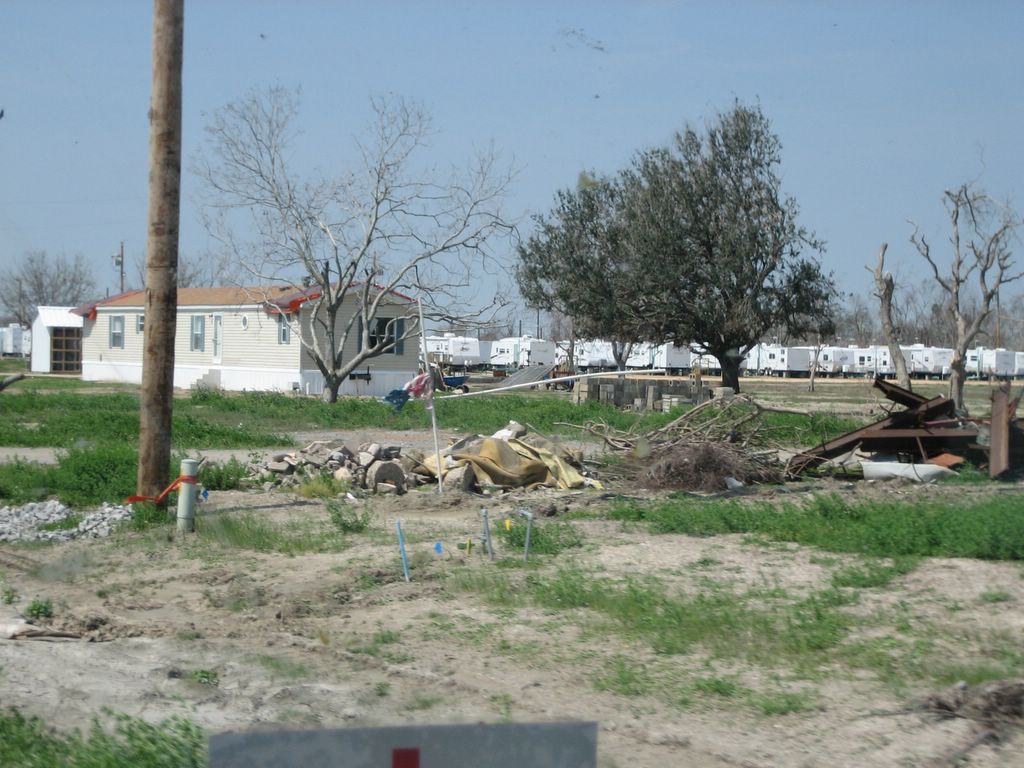
One of three landfills marked "RITA dump site" in Cameron parish along Hwy 82. The amount of debris is staggering. Downed trees seem to be taken elsewhere and we saw a number of deliberate debris fires. This part of the parish only housed about 6000 people, max. Imagine the dump sites near New Orleans.


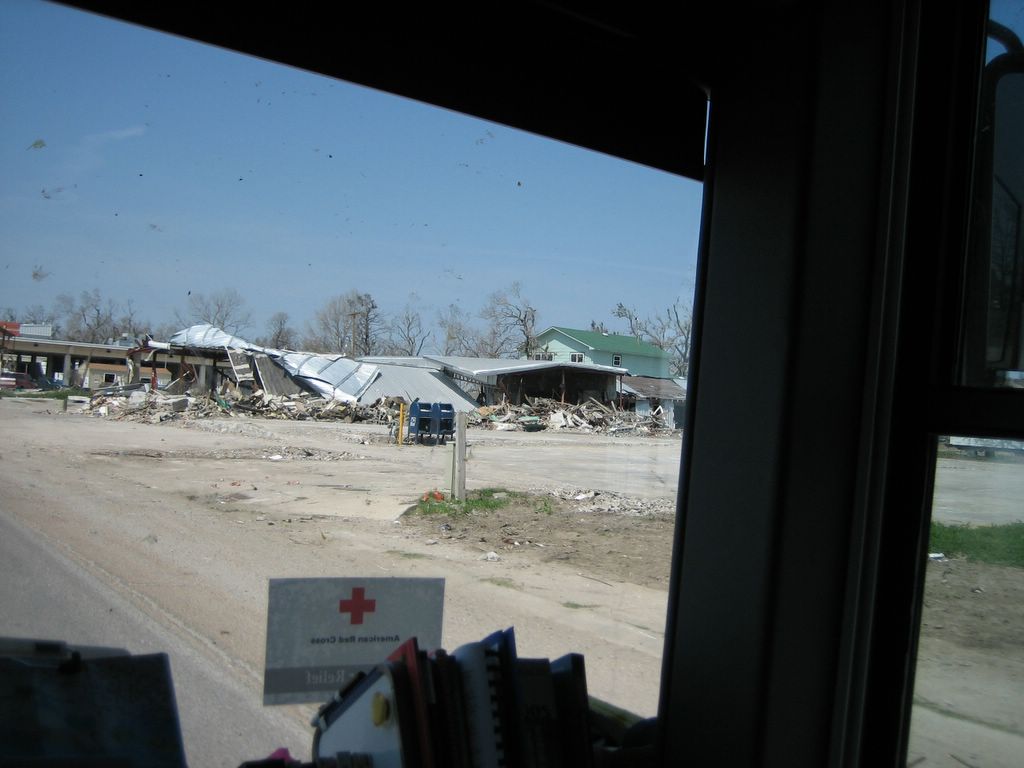

Houston traffic is baaaaaaad. The major east-west freeway, I10, seems to always be backed-up and the construction doesn't help. We took this HOV lane without knowing when it would merge back into the snarled main lanes to our right. Fortunately, the lane ended at our exit and we bypassed about 10 miles of stop-and-go in favor of smooth sailing in our (almost completely) private lane. Considering how often we make wrong turns in our travels, finding the lowest trees and wimpiest bridges, it is nice to occasionally choose just the right route.


Monday, March 20, 2006
Wet in Houston
We are parked at the Peace Community Church, on the western edge of Houston (map). Yesterday morning, Louise's brother, David, was ordained as pastor here, and we attended the ceremony. David is in the process of moving his family here from British Columbia, and we had a nice visit with them as well as Louise's dad and stepmom, who flew in for the occasion.
A line of thunderstorms has just passed through here, and things are very wet. Also, Opal (who hates thunder) is nervous. We have a little break in the weather right now, and we are preparing to get under way. We have been in this spot since Friday evening, but we've been too busy with family to post.
Friday we drove through Cameron Parish, LA, and had a chance to see the progress since our last visit late last year. For anyone who is not familiar with the story, here is a quick checklist of Cameron Parish communities and facilities:
Today we will be leaving Houston in the general direction of Austin.
A line of thunderstorms has just passed through here, and things are very wet. Also, Opal (who hates thunder) is nervous. We have a little break in the weather right now, and we are preparing to get under way. We have been in this spot since Friday evening, but we've been too busy with family to post.
Friday we drove through Cameron Parish, LA, and had a chance to see the progress since our last visit late last year. For anyone who is not familiar with the story, here is a quick checklist of Cameron Parish communities and facilities:
- Grand Chenier: Obliterated. Hard to tell there was a town here at all.
- Creole: Obliterated. Part of a church is the only thing standing.
- Cameron: The oil facilities show signs of life. The courthouse still stands and houses the entire parish government, in the form of an EOC. A couple of enterprising folks have hauled trailers into town and opened restaurants in them, which were doing a very brisk business with the contractors when we passed through at lunch time.
- Cameron Ferry: Fully operational. No fares are being collected.
- Holly Beach: Gone. Only the water tower remains. Many residents have cleared their properties, but no rebuilding is happening yet.
- Ocean View Beach: This small cluster of stilt homes was completely gone in December. On this pass, two structures had been completely rebuilt (perhaps with modular construction) and were occupied.
- Johnson's Bayou: Part of a church survived the storm. Other structures were still in various states of destruction. Many folks seem to be living in trailers on the oil production property near town.
Today we will be leaving Houston in the general direction of Austin.
Friday, March 17, 2006
Back in Cajun country
We are at the Wal-Mart in Abbeville, LA (map). This stop is familiar to us, since we were here last January, on more or less the same route. We are, again, heading for the Cameron ferry. We came through Cameron Parish in December in a Red Cross car, looking for antenna sites. The entire parish was destroyed by Rita, and recovery has been very slow. We are hoping to see some signs of progress as we drive through today.
We wrapped up our work with the Red Cross in Metairie yesterday, and hit the road around lunch time. It was a rewarding couple of weeks, and we were made to feel valued and welcome. We will be seeing some of the same people in our training class that begins just two weeks from now.
A number of people have written in to note that the Datastorm Users map has showed us in the middle of Lake Ponchartrain for the last few days. (In contrast, the map link I posted on the blog was a generic one for Metairie, LA). I want to reassure you that we are still quite dry, and did not run off the causeway into the lake! The weird position location was an artifact of how the DSLocator software, which updates our map position, handles "approximate" locations.
You may recall that the locations of the Red Cross facilities we have been working at, while not state secrets, have not been public information (for the simple reason that we did not have any client support activities there, and clients will swarm to anything labeled Red Cross). Consequently, we have been careful not to disclose those locations through our map links. DSLocator normally uplinks a highly accurate position -- so accurate, that readers of this site have shown up, unannounced, on our doorstep by following the maps. It has an option, instead, to uplink an "approximate" location. It does this by rounding the decimal latitude and longitude coordinates to the nearest tenth of a degree. In the case of our location in Metairie, that rounding put our icon in the lake.
Today we will drive the Louisiana gulf coast along the Creole Nature Trail, cross the Sabine Pass into Texas, and head directly to Houston.
We wrapped up our work with the Red Cross in Metairie yesterday, and hit the road around lunch time. It was a rewarding couple of weeks, and we were made to feel valued and welcome. We will be seeing some of the same people in our training class that begins just two weeks from now.
A number of people have written in to note that the Datastorm Users map has showed us in the middle of Lake Ponchartrain for the last few days. (In contrast, the map link I posted on the blog was a generic one for Metairie, LA). I want to reassure you that we are still quite dry, and did not run off the causeway into the lake! The weird position location was an artifact of how the DSLocator software, which updates our map position, handles "approximate" locations.
You may recall that the locations of the Red Cross facilities we have been working at, while not state secrets, have not been public information (for the simple reason that we did not have any client support activities there, and clients will swarm to anything labeled Red Cross). Consequently, we have been careful not to disclose those locations through our map links. DSLocator normally uplinks a highly accurate position -- so accurate, that readers of this site have shown up, unannounced, on our doorstep by following the maps. It has an option, instead, to uplink an "approximate" location. It does this by rounding the decimal latitude and longitude coordinates to the nearest tenth of a degree. In the case of our location in Metairie, that rounding put our icon in the lake.
Today we will drive the Louisiana gulf coast along the Creole Nature Trail, cross the Sabine Pass into Texas, and head directly to Houston.

Sunday, March 12, 2006
Hard times in the Big Easy
We are in Metairie, Louisiana (generic map). After successfully moving the Red Cross Baton Rouge headquarters from a church to a union hall, we were winding down our visit and getting ready to move on down the road, when our supervisor asked if we could stay a few days longer to support the joint relief operation here in Metairie with the Southeast Louisiana chapter. We are sharing temporary space here in a commercial building, since the chapter offices in New Orleans were destroyed in the storm.
We don't really need to be in Houston until the 17th or so, so we agreed to come down here until then. We spent Wednesday night parked at the church in Baton Rouge, tending the pre-move server backup, which ran until 5am and required tape changes every couple hours. Then we moved to the union hall, where we thought we'd be staying for a couple days, and staked out a nice spot with a 20-amp outlet. We were barely plugged in when the decision was made to come here, and we set out from Baton Rouge that evening in the still-horrendous post-Katrina rush hour.
We have a nice spot in a gravel lot just two blocks from the Metairie office. The Red Cross has arranged for this space to park trucks and overflow cars, but, frankly, there are trailers parked on every block in this town, and we probably could get away with parking anywhere. The nearby K-Mart has a half-dozen FEMA trailers in it, hooked up with semi-permanent water, sewer, and electric connections.
Being down here has allowed us to pop over to New Orleans for dinner the past two nights. We also spent a good chunk of today downtown, and we noted, over cafe-au-lait and beignets at Cafe du Monde, that tourism is back in nearly full-force. The FEMA encampment that had been such a prominent feature next to the Jax brewery in December is gone, and everywhere in the quarter things seem very close to routine. Outside of the quarter and the CBD, of course, the city is still very much a disaster area.
We are committed to being here through Tuesday, the thought being that we would be back in Baton Rouge for the traditional Tuesday steak dinner. It looks, though, like we are needed beyond that, so we will have to see how things play out. We have our supervisor's car while he is away from the operation for a few days, and we need to get that back to him Tuesday night in any case.
We don't really need to be in Houston until the 17th or so, so we agreed to come down here until then. We spent Wednesday night parked at the church in Baton Rouge, tending the pre-move server backup, which ran until 5am and required tape changes every couple hours. Then we moved to the union hall, where we thought we'd be staying for a couple days, and staked out a nice spot with a 20-amp outlet. We were barely plugged in when the decision was made to come here, and we set out from Baton Rouge that evening in the still-horrendous post-Katrina rush hour.
We have a nice spot in a gravel lot just two blocks from the Metairie office. The Red Cross has arranged for this space to park trucks and overflow cars, but, frankly, there are trailers parked on every block in this town, and we probably could get away with parking anywhere. The nearby K-Mart has a half-dozen FEMA trailers in it, hooked up with semi-permanent water, sewer, and electric connections.
Being down here has allowed us to pop over to New Orleans for dinner the past two nights. We also spent a good chunk of today downtown, and we noted, over cafe-au-lait and beignets at Cafe du Monde, that tourism is back in nearly full-force. The FEMA encampment that had been such a prominent feature next to the Jax brewery in December is gone, and everywhere in the quarter things seem very close to routine. Outside of the quarter and the CBD, of course, the city is still very much a disaster area.
We are committed to being here through Tuesday, the thought being that we would be back in Baton Rouge for the traditional Tuesday steak dinner. It looks, though, like we are needed beyond that, so we will have to see how things play out. We have our supervisor's car while he is away from the operation for a few days, and we need to get that back to him Tuesday night in any case.
Thursday, March 9, 2006
Sean and our lovely friend Anne at Tuesday night steak dinner, a Baton Rouge RTT tradition. This ratty local bar has a BBQ grill on the back patio, and on Tuesday nights they serve a most excellent ribeye steak dinner. 15 bucks for a huge steak, baked potato, green salad and a roll. Beer is extra, but not much extra...if I recall correctly, a bucket of 6 beers is about $10. The bar used to grill the steaks only on Tuesdays during the summer, but since 10 to 30 Red Cross people started showing up each week, they extended the dinners through the winter. Our favorite waitress, Michele, knows everyone's name and so this nondescript tavern in a dark industrial area has become our "Cheers." It is such sacred tradition that RTT people have been known to change their flights home for one final "Steak Night," and when our boss told us we would be working all night Tuesday to move HQ to a new location, he said, "Of course, we'll have steak night first, then move headquarters." Fortunately, the moved ended up happening Wednesday so we could enjoy our dinner with no worries about working afterwards. By the way, the bar is walking distance to Odyssey's parking space, so don't worry about those beers, Mom.

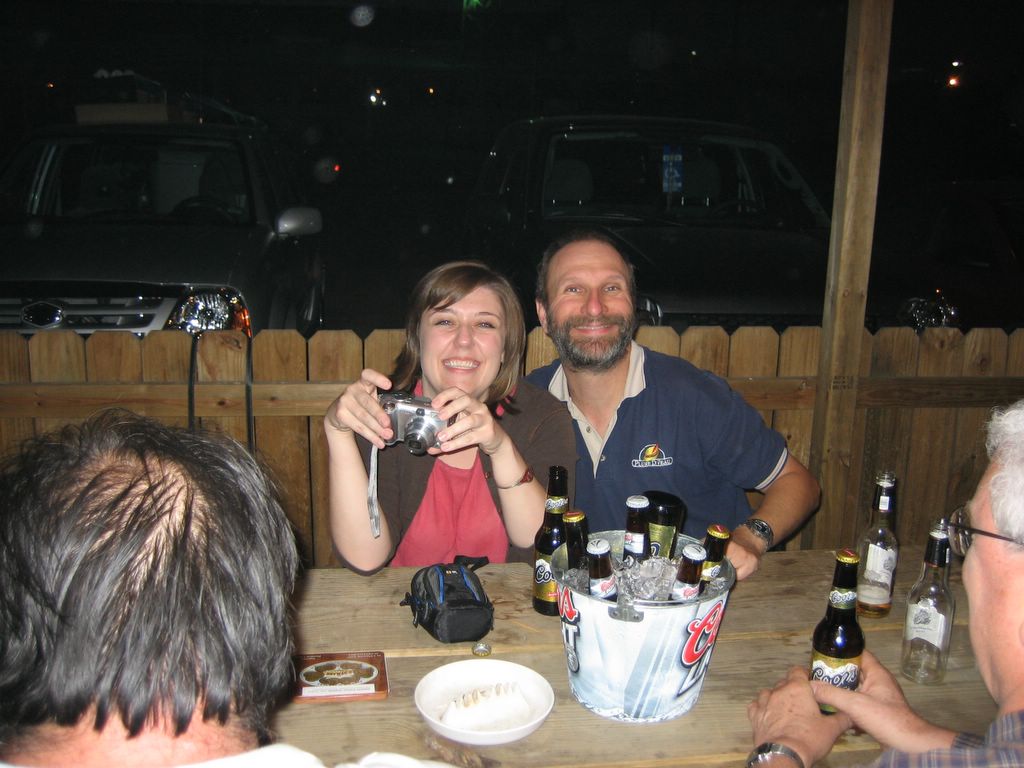
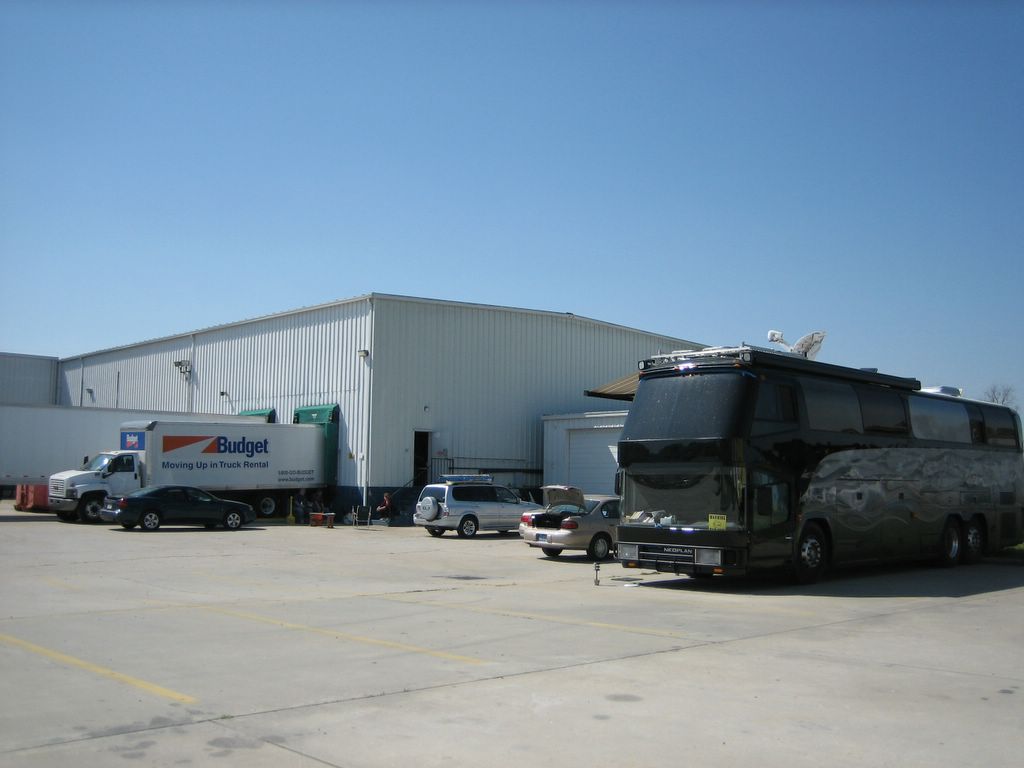
Our Red Cross digs this visit. Because the temporary new headquarters were so small, the RTT warehouse was housed in this building on a piece of property owned by a local trucking company. The parking lot was completely surrounded by a chainlink fence, so for a short time we lived in this lovely gated community.

Sunday, March 5, 2006
Just like home -- Baton Rouge
We are once again in Baton Rouge, stationed at a Red Cross logistics warehouse that is serving as the technology service center. Once again, I am not posting our exact location either here or on the DataStorm site. In contrast to our previous digs, we have access to a 20-amp electrical outlet here.
We arrived Friday afternoon and got signed in, and by Saturday morning I was already out in the field, moving phone lines around in a warehouse in Reserve. We are really here, though, because the entire operation will be moving (again) into a different HQ this week, and moves need an all-hands effort. We will be here for about a week, just enough to help move and maybe a few other things,, before family commitments have us en route to Houston.
It feels almost like coming home. Part of that is because we do feel a sense of family with the Red Cross, and part is that, having spent ten weeks here, Baton Rouge is the single place where we have spent the most time since we hit the road in Odyssey 18 months ago.
I suspect, now that we are working full hours, that I will not be updating the blog much until we leave here.
We arrived Friday afternoon and got signed in, and by Saturday morning I was already out in the field, moving phone lines around in a warehouse in Reserve. We are really here, though, because the entire operation will be moving (again) into a different HQ this week, and moves need an all-hands effort. We will be here for about a week, just enough to help move and maybe a few other things,, before family commitments have us en route to Houston.
It feels almost like coming home. Part of that is because we do feel a sense of family with the Red Cross, and part is that, having spent ten weeks here, Baton Rouge is the single place where we have spent the most time since we hit the road in Odyssey 18 months ago.
I suspect, now that we are working full hours, that I will not be updating the blog much until we leave here.
Friday, March 3, 2006
Recovery encampment, Pass Christian
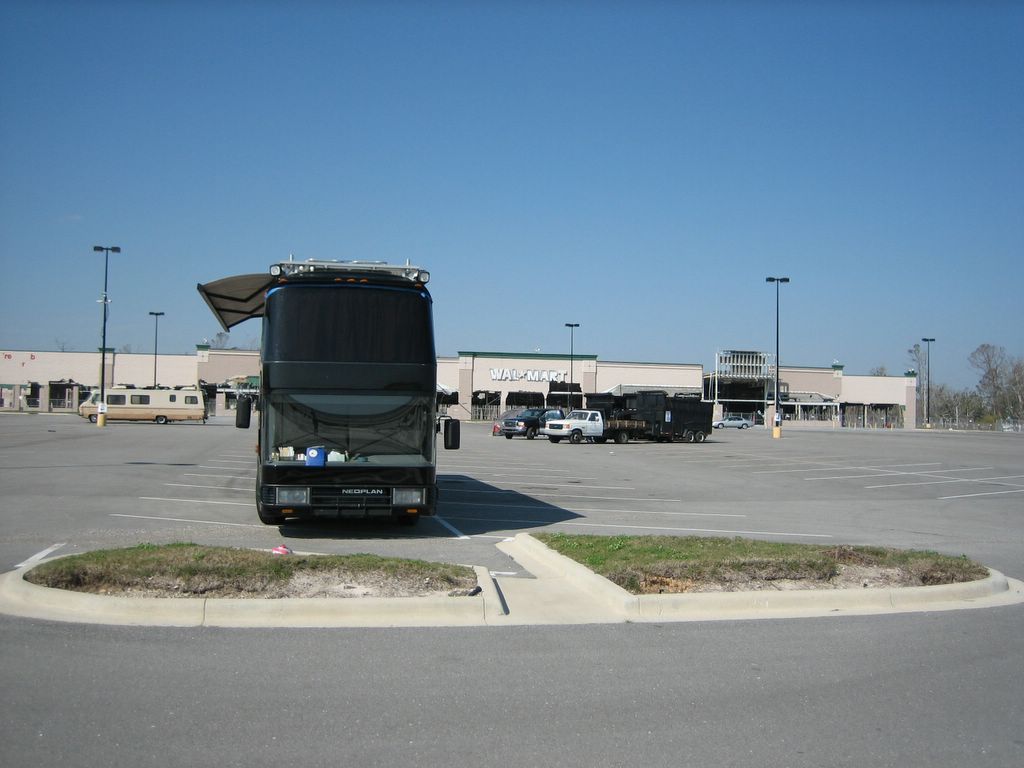
As Louise has already documented with a photo, we are parked at a destroyed Wal-Mart in Pass Christian, Mississippi, less than a hundred yards from the Gulf of Mexico (map). We have a beautiful panoramic view of the gulf out our front window.
This store was brand spanking new when we passed through here last January. My recollection is that overnight parking, as well as parking for the beach, was not allowed. Now it is home to perhaps a dozen recovery contractors in camps scattered throughout the expansive parking lot. Many are sleeping in their trucks, a few are in tents (and what a curious sight that is, in the asphalt lot), and a lucky handful have small travel trailers or motor homes. One is even living in a school bus, still yellow but with curtains over the windows.
Wal-Mart has done a good job cleaning the property up -- the store is empty of debris and fenced off with a temporary cyclone fence (and isn't that an ironic name for it?), the parking lot is swept clean, and the dead trees have been removed. It is eerily familiar, with the hulk of the store in the background, but the complete absence of light in the parking lot (the immense parking lot lights survived the storm, but the power is off), the ghostly remains of the gas station, and the utter absence of patrons' cars combine with the small circled encampments to give the place the feel of one of those B-grade after-the-holocaust films. Not far from the truth, I guess.
A block to the west can be seen a pair of circus-sized tents surrounded by travel trailers, box vans, and generators, a loosely organized grass-roots feeding operation known as God's Katrina Kitchen. On the horizon to the south we can make out the silhouette of Cat Island.
Yesterday afternoon we walked around the block, which took us half a mile inland as the ground rises gently from the beach. No structures are standing within the first thousand feet from the highway, but as one climbs further a line of partially-destroyed houses slowly gives way to mostly intact structures and then some with either minimal damage or fully repaired. From the highway, though, the scene is endless, utter, and complete destruction. There is not a single intact structure from Gulfport to Pass Christian.
The pictures and video from this area do not adequately convey the enormity of the situation. To the casual observer, it looks as if the storm came through here yesterday, though it has been over six months. Few casual observers will see this, though -- we are on a stretch of highway between two closed bridges (one between Ocean Springs and Biloxi, the other between Pass Christian and Bay St. Louis), the road decks ripped off their piers by the storm. Mississippi has elected not to repair them, waiting, instead, for federal funding to replace them with more modern structures.
Just as well that few people travel this stretch -- there are no services whatsoever. US90 has been mostly repaired and reopened, but the dozens of traffic signals on the route are gone, the empty stanchions a grim reminder of how much infrastructure remains to be fixed. Missing storm drain grates and manhole covers make a stroll down the street a less-than-casual affair. Street lights are working now on the side streets, and there appears to be a network of temporary water mains serving the inland buildings that are habitable.
We saw Mardi Gras beads littering the highway yesterday, and signs prohibiting parking during the parade. We would guess that the celebration here was bittersweet, but clearly well attended. (Which reminds me that our visit to Mobile on Ash Wednesday revealed the scope of the celebration there -- forget New Orleans, I want to go to Mobile for Mardi Gras!)
All in all, a very sobering visit to this part of the gulf coast. It makes us glad that we will be checking in with the Red Cross this afternoon for another, albeit brief, stint.
This store was brand spanking new when we passed through here last January. My recollection is that overnight parking, as well as parking for the beach, was not allowed. Now it is home to perhaps a dozen recovery contractors in camps scattered throughout the expansive parking lot. Many are sleeping in their trucks, a few are in tents (and what a curious sight that is, in the asphalt lot), and a lucky handful have small travel trailers or motor homes. One is even living in a school bus, still yellow but with curtains over the windows.
Wal-Mart has done a good job cleaning the property up -- the store is empty of debris and fenced off with a temporary cyclone fence (and isn't that an ironic name for it?), the parking lot is swept clean, and the dead trees have been removed. It is eerily familiar, with the hulk of the store in the background, but the complete absence of light in the parking lot (the immense parking lot lights survived the storm, but the power is off), the ghostly remains of the gas station, and the utter absence of patrons' cars combine with the small circled encampments to give the place the feel of one of those B-grade after-the-holocaust films. Not far from the truth, I guess.
A block to the west can be seen a pair of circus-sized tents surrounded by travel trailers, box vans, and generators, a loosely organized grass-roots feeding operation known as God's Katrina Kitchen. On the horizon to the south we can make out the silhouette of Cat Island.
Yesterday afternoon we walked around the block, which took us half a mile inland as the ground rises gently from the beach. No structures are standing within the first thousand feet from the highway, but as one climbs further a line of partially-destroyed houses slowly gives way to mostly intact structures and then some with either minimal damage or fully repaired. From the highway, though, the scene is endless, utter, and complete destruction. There is not a single intact structure from Gulfport to Pass Christian.
The pictures and video from this area do not adequately convey the enormity of the situation. To the casual observer, it looks as if the storm came through here yesterday, though it has been over six months. Few casual observers will see this, though -- we are on a stretch of highway between two closed bridges (one between Ocean Springs and Biloxi, the other between Pass Christian and Bay St. Louis), the road decks ripped off their piers by the storm. Mississippi has elected not to repair them, waiting, instead, for federal funding to replace them with more modern structures.
Just as well that few people travel this stretch -- there are no services whatsoever. US90 has been mostly repaired and reopened, but the dozens of traffic signals on the route are gone, the empty stanchions a grim reminder of how much infrastructure remains to be fixed. Missing storm drain grates and manhole covers make a stroll down the street a less-than-casual affair. Street lights are working now on the side streets, and there appears to be a network of temporary water mains serving the inland buildings that are habitable.
We saw Mardi Gras beads littering the highway yesterday, and signs prohibiting parking during the parade. We would guess that the celebration here was bittersweet, but clearly well attended. (Which reminds me that our visit to Mobile on Ash Wednesday revealed the scope of the celebration there -- forget New Orleans, I want to go to Mobile for Mardi Gras!)
All in all, a very sobering visit to this part of the gulf coast. It makes us glad that we will be checking in with the Red Cross this afternoon for another, albeit brief, stint.
Thursday, March 2, 2006

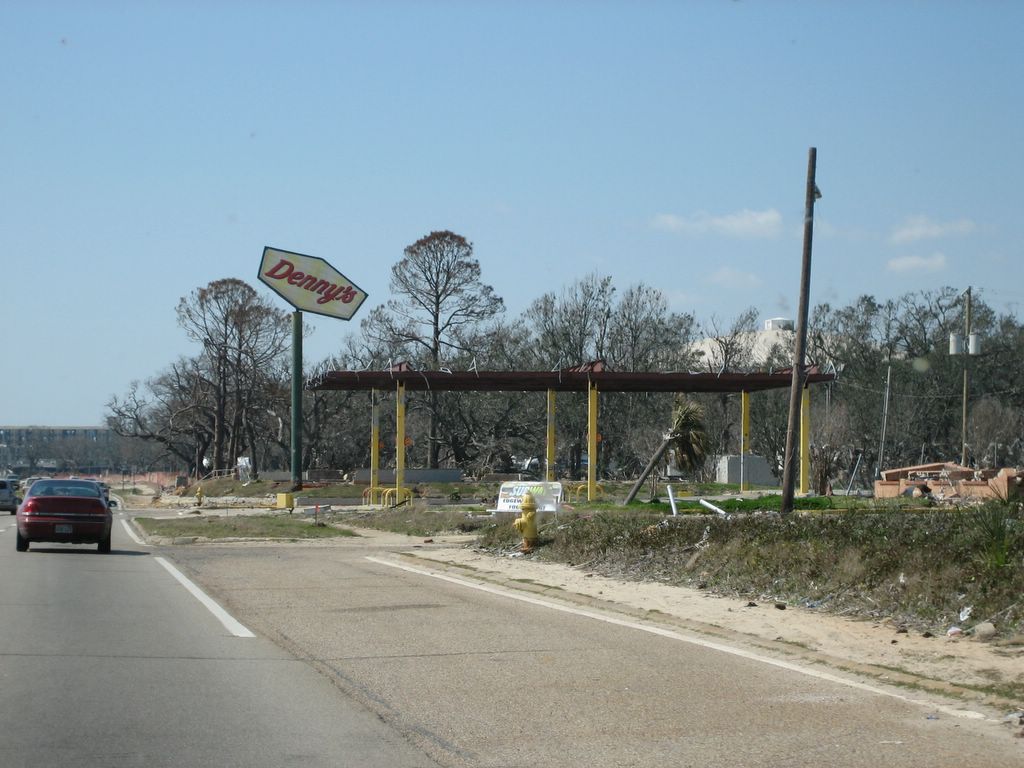
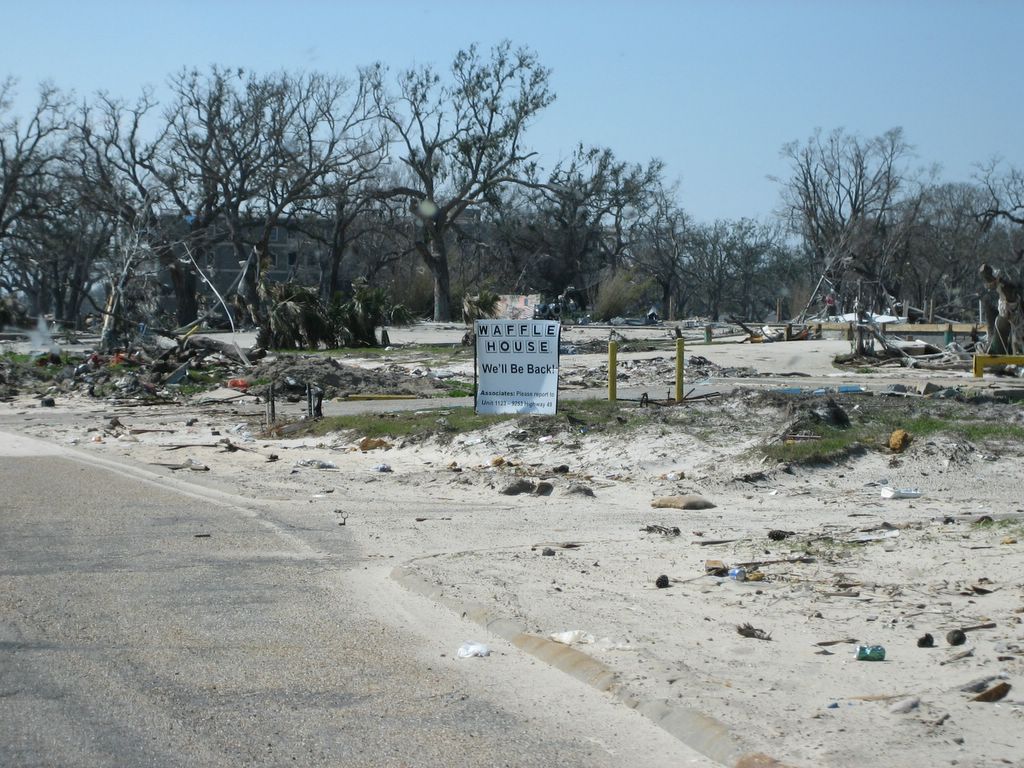
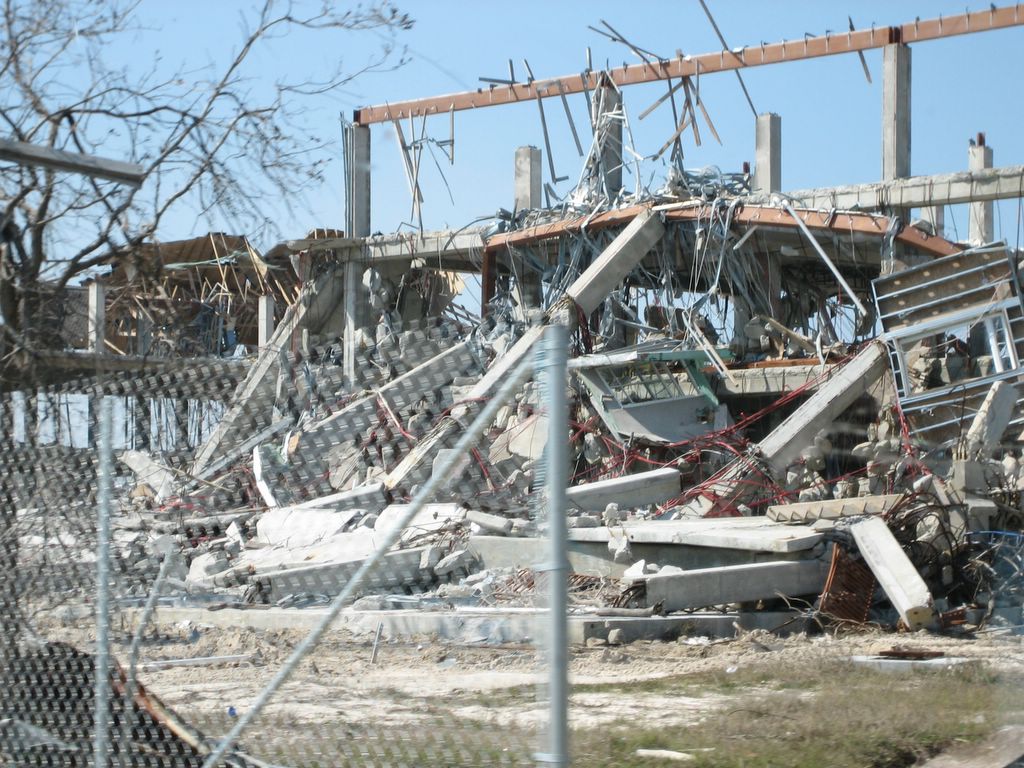
Without the sign, how would you know what had ever been here? On other piles of rubble we saw spray painted identification: restaurants, motels, private homes, churches. No street signs, no landmarks, but amazingly intact oak trees. I suppose a local resident might recognize individual trees and feel some relief that these old friends had survived.

Damn the torpedoes, full speed ahead!
Yesterday turned out to be a day of some frustration.
After leaving Milton, we had an uneventful drive through Pensacola, and, in fact, US90 runs along the western shore of Escambia Bay, which we found to be quite beautiful. We did notice more and more hurricane damage, though, as we proceeded south and west.
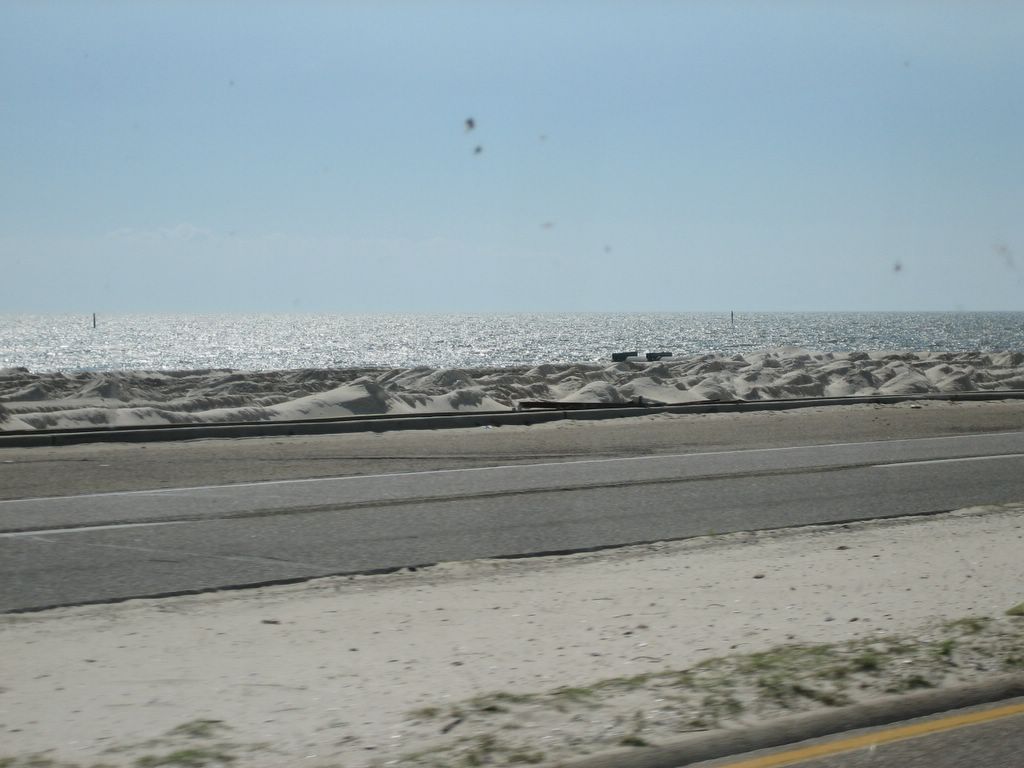
From the western edge of Pensacola, we retraced our route of last January, down to Perdido Key and along the gulf into Gulf Shores, Alabama. Sadly, the scene along there was eerily reminiscent of that earlier transit, over a full year ago. While not yet fully recovered from Ivan, Katrina slammed ashore and undid much of the progress. We did note that many of the damaged structures from a year ago are gone, I am guessing due to the bulldozers I forecast then, although some may have been taken by Katrina's surge. We also noted, in contrast to last year, that enough progress has been made in the area that many buildings are again occupied, and many local businesses are open. Still, though, a sobering drive.
From downtown Gulf Shores we drove the 25 miles or so west down the peninsula to the ferry landing at Fort Morgan State Park. We arrived noonish for a 1:15 ferry, and so spent half an hour or so walking around historic Fort Morgan. Constructed at the beginning of the 19th century as part of the defenses of Mobile Bay, in a style typical of that period, the fort became famous during the civil war. As the last bastion of confederate blockade-running, the union fleet, under command of Admiral D.G. Farragut, pressed a massive attack in 1864. As the fleet approached the fort, USS Tecumseh struck a confederate torpedo (what, today, we would call a mine) sending the ironclad to the bottom and causing the fleet to hesitate. This prompted Farragut to issue the now-famous command with which I have titled this post.
What I did not know, before arriving at the fort, was that it was refortified at the dawn of the 20th century as part of the US coastal defenses. The newer batteries for the large rifled guns are built in, around, and sometimes through the earlier fortifications. It is a weird and stark contrast, concrete bunkers inside of a brick-and-earthen pentagonal fort. Even the modern fortifications had been abandoned by WWII.
Nervous about getting a spot on the ferry, we cut short our tour and lined up at the ferry landing a good half hour before departure. And there we were, in the middle of the line, when the ferry pulled up to the dock and we realized, to our great disappointment, that there was no way Odyssey could embark the ferry -- the ramp was at too steep an angle, and she would certainly low-center on it, thus sidelining both us and the ferry until a tow truck could be summoned.
As we watched the ferry sail away, we consulted our trusty GPS and it's built-in tide tables to see if, perhaps, by waiting for a later ferry, the tide would come in enough to flatten the ramp to the point we could embark. Unfortunately, we discovered that, notwithstanding a high-water mark a good two feet above the waterline, all the rest of the day's ferries would be at even lower levels. Reluctantly, we left Fort Morgan and backtracked all the way to Gulf Shores.
We did stop in at the Gulf State Park, which claimed to have a few spaces left. The campground is in the middle of a huge recovery effort, and they are making good progress. That being said, we found it, in its current condition, to be rather unappealing, and, since it was only 2:00, we decided to press on to Mobile.
As it turns out, we have a club in Mobile, so we decided to find some nearby parking and have dinner there. We called the club and got some directions and the low-down on the parking situation, and headed into downtown. After driving around for 15 minutes or so looking for stealth boondocking locations, we decided to put Odyssey into a pair of metered spaces, where $0.75 bought us the last two hours before meter enforcement ended. At which point we called the ClubLine for our dinner reservations, only to be told that there is no dining at this club until Thursday night. Why, we wondered, did the club not tell us there was no dining when we called for directions? We told them we were coming for dinner!
We still had our paid-up time on the meters, and the dish was up and on-line, so we spent some time tracking down Wal-Marts and restaurants in Mobile, finally settling on an Olive Garden with a Sam's Club nearby. As it turned out when we arrived at the Olive Garden, it is in a shopping center that is maybe a 70%-30% mix of going concerns and for-lease stores. We parked in the back behind one of these latter items, and here we are still this morning (map). Urban stealth camping at its finest -- dark, quiet, undisturbed, and stumbling distance from a restaurant. Louise couldn't resist spending an hour or two in the stores after dinner, though, and came home with some new bedding.
I'd love to tell you what our plan is today, but my prediction track record over the past few days has been poor. I'll just say we are going to try to stay near the gulf, starting maybe near Pascagoula. We're not going to try to see Dauphin Island, chalking that up to a casualty of the ferry fiasco, and we did the loop south of here and into Bayou La Batre last year.
After leaving Milton, we had an uneventful drive through Pensacola, and, in fact, US90 runs along the western shore of Escambia Bay, which we found to be quite beautiful. We did notice more and more hurricane damage, though, as we proceeded south and west.
From the western edge of Pensacola, we retraced our route of last January, down to Perdido Key and along the gulf into Gulf Shores, Alabama. Sadly, the scene along there was eerily reminiscent of that earlier transit, over a full year ago. While not yet fully recovered from Ivan, Katrina slammed ashore and undid much of the progress. We did note that many of the damaged structures from a year ago are gone, I am guessing due to the bulldozers I forecast then, although some may have been taken by Katrina's surge. We also noted, in contrast to last year, that enough progress has been made in the area that many buildings are again occupied, and many local businesses are open. Still, though, a sobering drive.
From downtown Gulf Shores we drove the 25 miles or so west down the peninsula to the ferry landing at Fort Morgan State Park. We arrived noonish for a 1:15 ferry, and so spent half an hour or so walking around historic Fort Morgan. Constructed at the beginning of the 19th century as part of the defenses of Mobile Bay, in a style typical of that period, the fort became famous during the civil war. As the last bastion of confederate blockade-running, the union fleet, under command of Admiral D.G. Farragut, pressed a massive attack in 1864. As the fleet approached the fort, USS Tecumseh struck a confederate torpedo (what, today, we would call a mine) sending the ironclad to the bottom and causing the fleet to hesitate. This prompted Farragut to issue the now-famous command with which I have titled this post.
What I did not know, before arriving at the fort, was that it was refortified at the dawn of the 20th century as part of the US coastal defenses. The newer batteries for the large rifled guns are built in, around, and sometimes through the earlier fortifications. It is a weird and stark contrast, concrete bunkers inside of a brick-and-earthen pentagonal fort. Even the modern fortifications had been abandoned by WWII.
Nervous about getting a spot on the ferry, we cut short our tour and lined up at the ferry landing a good half hour before departure. And there we were, in the middle of the line, when the ferry pulled up to the dock and we realized, to our great disappointment, that there was no way Odyssey could embark the ferry -- the ramp was at too steep an angle, and she would certainly low-center on it, thus sidelining both us and the ferry until a tow truck could be summoned.
As we watched the ferry sail away, we consulted our trusty GPS and it's built-in tide tables to see if, perhaps, by waiting for a later ferry, the tide would come in enough to flatten the ramp to the point we could embark. Unfortunately, we discovered that, notwithstanding a high-water mark a good two feet above the waterline, all the rest of the day's ferries would be at even lower levels. Reluctantly, we left Fort Morgan and backtracked all the way to Gulf Shores.
We did stop in at the Gulf State Park, which claimed to have a few spaces left. The campground is in the middle of a huge recovery effort, and they are making good progress. That being said, we found it, in its current condition, to be rather unappealing, and, since it was only 2:00, we decided to press on to Mobile.
As it turns out, we have a club in Mobile, so we decided to find some nearby parking and have dinner there. We called the club and got some directions and the low-down on the parking situation, and headed into downtown. After driving around for 15 minutes or so looking for stealth boondocking locations, we decided to put Odyssey into a pair of metered spaces, where $0.75 bought us the last two hours before meter enforcement ended. At which point we called the ClubLine for our dinner reservations, only to be told that there is no dining at this club until Thursday night. Why, we wondered, did the club not tell us there was no dining when we called for directions? We told them we were coming for dinner!
We still had our paid-up time on the meters, and the dish was up and on-line, so we spent some time tracking down Wal-Marts and restaurants in Mobile, finally settling on an Olive Garden with a Sam's Club nearby. As it turned out when we arrived at the Olive Garden, it is in a shopping center that is maybe a 70%-30% mix of going concerns and for-lease stores. We parked in the back behind one of these latter items, and here we are still this morning (map). Urban stealth camping at its finest -- dark, quiet, undisturbed, and stumbling distance from a restaurant. Louise couldn't resist spending an hour or two in the stores after dinner, though, and came home with some new bedding.
I'd love to tell you what our plan is today, but my prediction track record over the past few days has been poor. I'll just say we are going to try to stay near the gulf, starting maybe near Pascagoula. We're not going to try to see Dauphin Island, chalking that up to a casualty of the ferry fiasco, and we did the loop south of here and into Bayou La Batre last year.
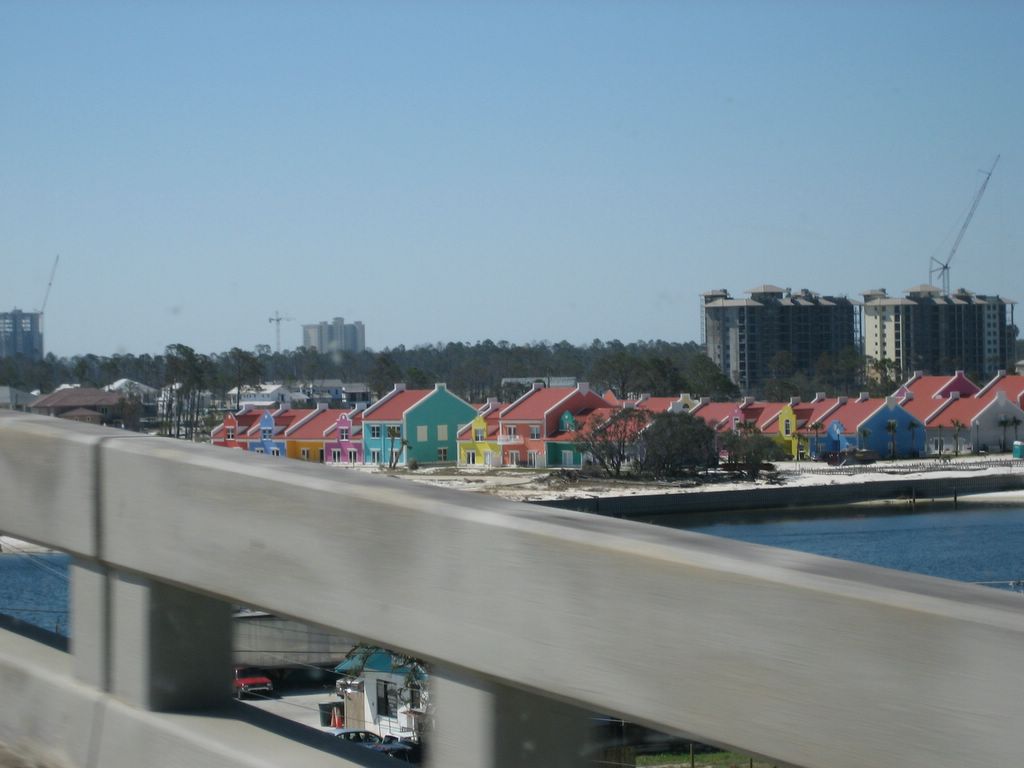
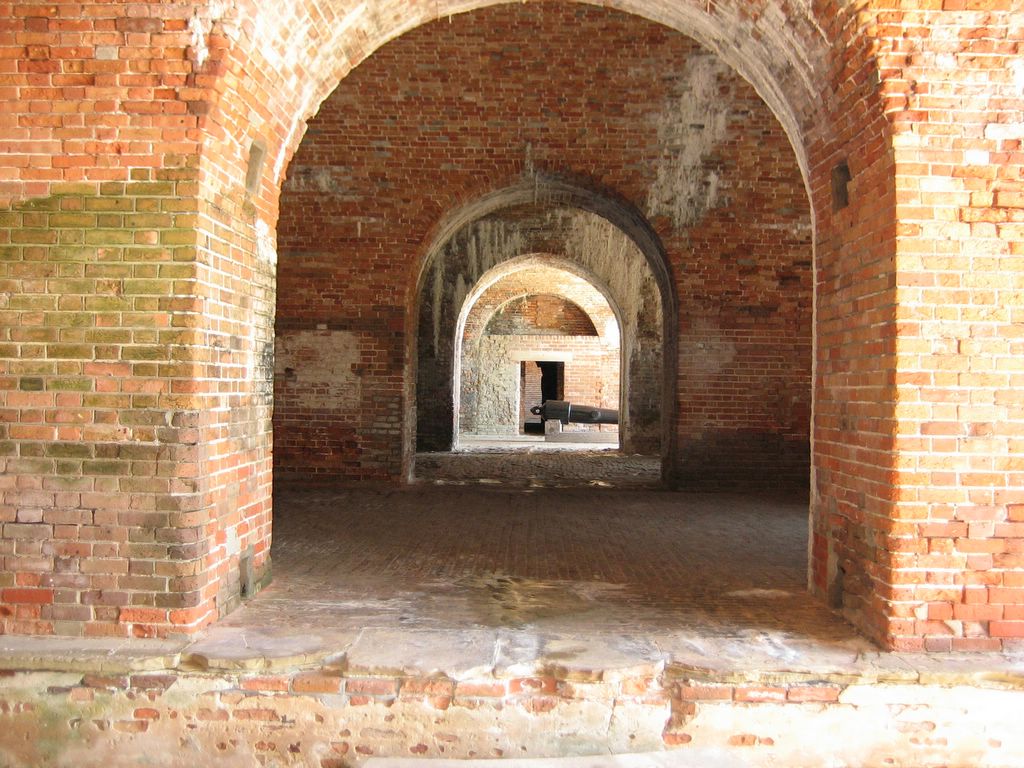
Subscribe to:
Posts (Atom)