Sunday, November 26, 2017

Happy Holidays, and Road Trip!

We are in Jacksonville, Florida, currently at the free city docks at Metropolitan Park (map). Long-time readers may remember we stayed here a couple of years ago. On this visit, as on that one, the normally pay-per-hour power is on full-time, and we put a scooter on the ground to run errands. There's water here, too, and we filled the tank and did some laundry before a water main broke, leaving us dry.

Jacksonville at night, from our anchorage near the hospital.

After my last post we moved upriver at slack to a familiar anchorage, at the intersection of the St. Johns and the ICW (map). It was too late in the day to go further, but we needed a more secure and comfortable anchorage than where we stopped after coming in from offshore. In the yard across from us was the 371' yacht Le Grand Bleu, presumably having work done. I'm sorry I did not get a photo.


Sunset at sea on our overnight passage.

Saturday morning on the flood we weighed anchor and cruised upriver to downtown Jacksonville. There was room at what's left of the free city dock at Jacksonville Landing, but we knew it would be noisy right there in front of Fionn McCool's on a Saturday night, and we opted instead to continue through the railroad bridge and anchor in another familiar spot, near Baptist Hospital (map). We had anchored here two years ago as well, after finding an ear-splitting music festival at Metropolitan Park.


Carnival liner in port, seen in our wake.

The cruise upriver was pleasant and interesting. We passed a Carnival cruise ship in port; here in Jacksonville the cruise terminal is a long way from town. We also passed the Independence, of American Cruise Lines, docked at a repair yard with her sister ship, American Star. We had just seen the Independence a week ago in Charleston, so she just came out of service. I had to chat with the crews, as they were planning to jockey them around just after we passed.


American Star and Independence at the shipyard.

After we settled in to our anchorage we splashed the tender. It was a beautiful day so after lunch we headed ashore to the free dock at Riverside Park. The Saturday Arts Festival was in full swing and we enjoyed walking around. A handful of high-zoot food trucks made us regret having had lunch aboard. A youth orchestra was playing on the concrete stage under the I-95 bridge. We're glad this nice entertainment space mostly survived the Irma flooding.


Youth orchestra on stage at the Arts Fest.

Monday we had a visit from friends Steph and Martin, who were on their way from their new home in St. Pete to Myrtle Beach for Thanksgiving. We had a nice lunch with them in the upscale cafe in the Museum of Contemporary Art. The museum is closed Mondays, but the MOCA cafe is open. Once again there were some wonderful food trucks in the park across the street.


Musicians and dancers at the weekly festival.

Having conceded that we'd be having Thanksgiving dinner in Jacksonville someplace, after lunch we walked to the Hyatt hotel on the riverfront, which I remembered from my Christmas research two years ago as having a nice holiday meal service. We were somewhat surprised to find the entire first floor, which had contained the lobby, registration, the restaurant, and a nice cocktail lounge entirely walled off. Registration was being conducted at the coat check for the second floor ballrooms, and a makeshift restaurant and cocktail lounge had been created in one of the ballrooms.


Approaching Jacksonville from downriver. Main Street lift bridge directly ahead.

When Irma hit this part of Florida it created record flooding on the St. Johns river. The river raced through downtown Jacksonville, flooding anything along the riverfront to a depth of four feet. Much of the ground level of Jacksonville Landing was damaged, and the first floor of the Hyatt was destroyed. Most of the Landing docks were also destroyed or damaged; what's left is in bad shape, but there is room for a couple of cruising boats.


Typical damaged section of the concrete floating docks. Some were swept away altogether.

We happened to drop in to Ruth's Chris steakhouse one evening just to dine on their reasonable happy hour bar menu, an easy tender ride from our anchorage. While there, we learned they were doing a full turkey dinner on Thanksgiving, and although it was sold out, we put our name on the waiting list. The very next day they called me back and we scored reservations for 4:45.


The luxury yacht Kismet has been moored on the riverfront since we arrived.

We were already here at the dock when Thanksgiving rolled around, and had figured we'd scooter across the river for dinner. But it was pouring rain all day, and we ended up doing Uber/Lyft instead. We had a very nice meal, and Ruth's Chris even made little leftover to-go boxes for everyone, so we have another turkey dinner last night.

The big thing we had to get done here in Jacksonville was to get the new scooter properly licensed and registered in Florida. So last week I rode down to the Clay County Tax Assessor's office in Orange Park, paperwork in hand, to get it done. With an out-of-state purchase, they actually want to see the bike and verify the VIN.


Vector anchored off the Baptist Health center.

I was at the counter for nearly an hour, owing mostly to the fact that I wanted to get some credit for fees already paid on the scooter that was stolen. That made for an out-of-normal-process transaction for the clerk, and she struggled to get it all through the byzantine computer system. Ultimately my fees went from $220 down to about $120. Sadly, VECTOR 1 is gone forever now, and I had to settle for VECTOR 3 as the new license plate. which will come in the mail. I have a regular motorcycle plate in the interim.

The very next day I rode right past the tax collector and another ten miles further to Green Cove Springs, where we "live," to pick up the mail from our mail service. I knew there was a fire extinguisher in the bundle (a result of the massive Kidde recall) so it was a lot cheaper and more convenient to pick it up in person.
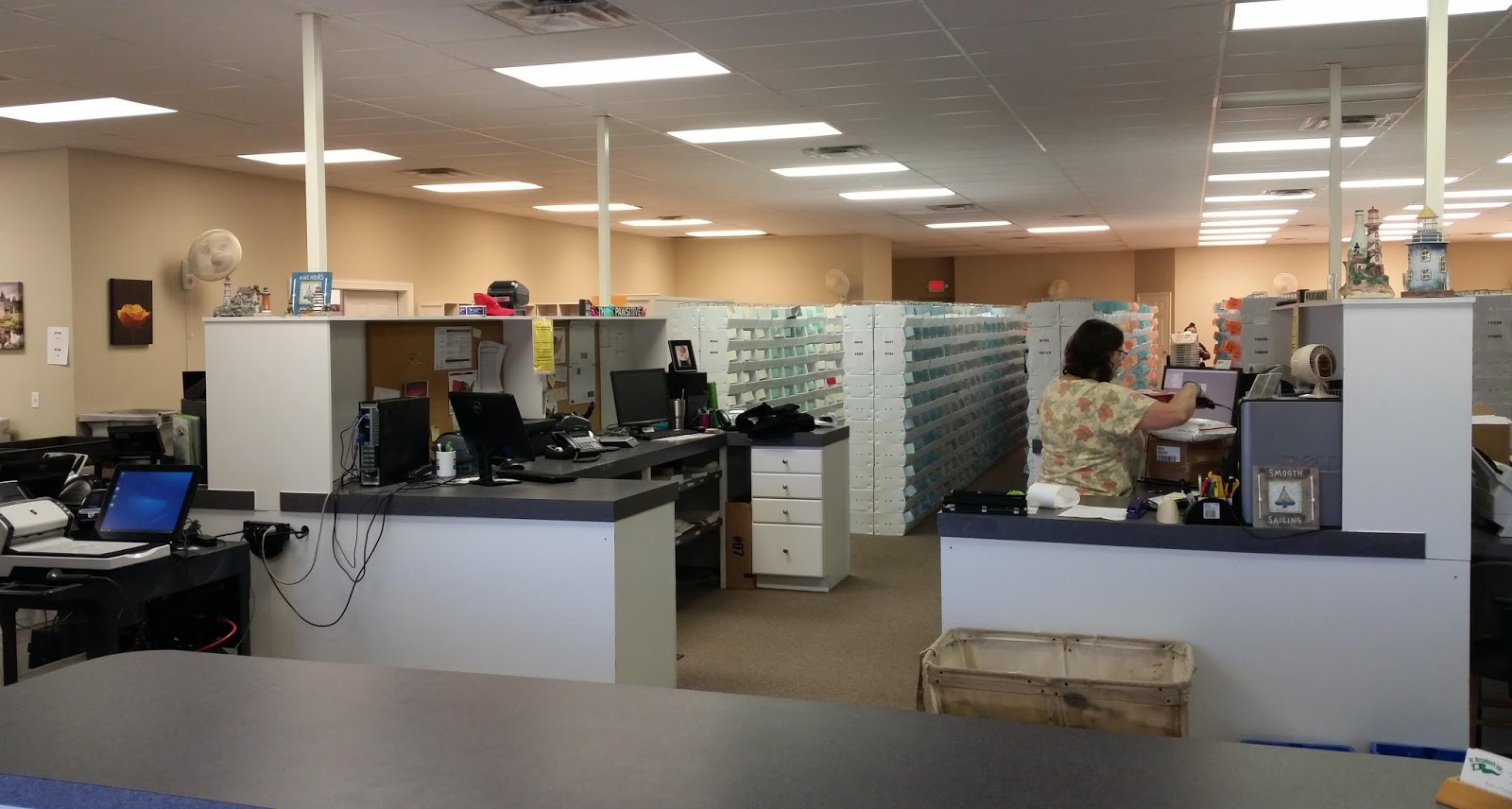

Our "home," St. Brendan's Isle mail service.

In between holiday meals, on-scooter errands (including provisioning the boat), and spending a little time in town, I've been getting some projects done. The cheap eBay-sourced wireless remote control I installed on the windlass a few years ago was getting intermittent, most likely due to the very cheap buttons wearing out, and I replaced the whole control unit with a different inexpensive model from Harbor Freight.

I also re-strung the port pilothouse blind, whose cord failed spectacularly during the passage. We had these same blinds on the bus for nine years with nary a problem, but on the boat the little stainless steel pins that the cords pass over tend to rust over time (yes, stainless can rust) in the salt air, and the rough rusty patches take their toll on the cords. This is the fourth one I've had to re-string; I'm getting pretty good at it.


Vector at the dock at Metropolitan Park.

With the new scooter on the ground I was also able to install ground-effect lights and auxiliary turn indicators in the otherwise empty light sockets on the fairing (US regulations have the manufacturer abandoning the fairing sockets for stalk-mounted units on the handlebars). I had done both of these projects on Chip and was happy with the increase in visibility.

Yesterday a pair of sailboats showed up here at the dock, and one of them was none other than the unlucky soul who lost his anchor in Charleston. I had interacted with them a bit on Facebook; we enjoyed meeting them in person. They also lost twenty feet of chain. Their pulpit now sports a shiny new Rocna which they had to pick up at West Marine. The anchor they lost was a Bruce, like ours, no longer made and now Unobtainium.
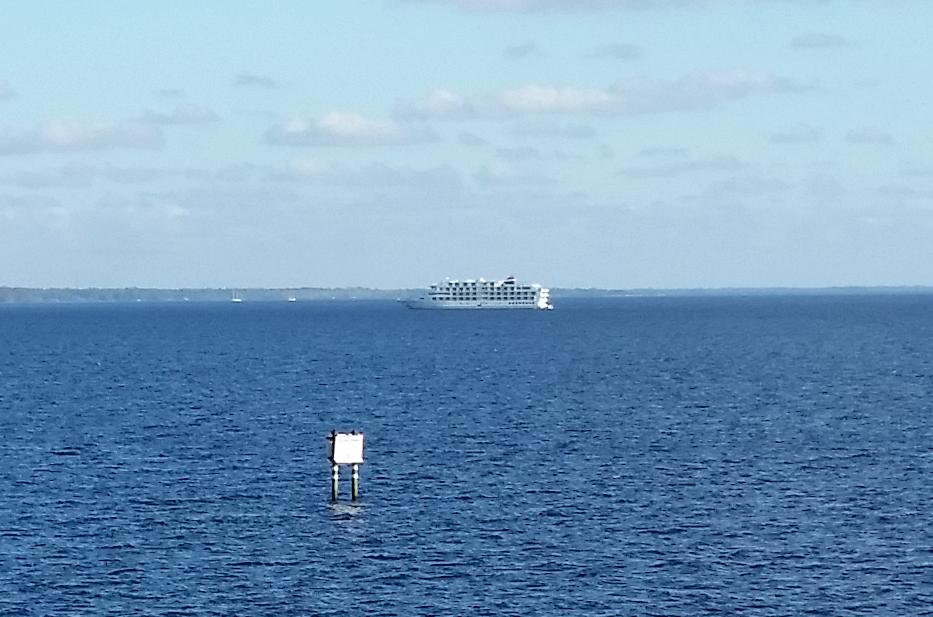

Our old friend American Constellation, anchored off Green Cove Springs.

We've been scratching our heads a bit about where to go from here, now that our errands here are done. We need to end up in Fort Lauderdale within a month or so, where our new stabilizer fins will be waiting for us and where we know someone who can get our watermaker back up to snuff, long overdue. And we may or may not make a detour across the lake to the west coast first.

Somewhere in all of the discussions I mentioned that I would like to maybe get in a visit to Disney while we're here in Florida, and because Steph said she might be interested, I ended up spending a full day doing the research. Complicating things is the fact that the cat is so old now that we prefer not to kennel her, so we wanted to bring her with us.


Downtown, from the Ortega River drawbridge. I had to wait for the span on my way back from Green Cove Springs.

I surprised even myself when, after hours of juggling pet policies and the exorbitant $50/day pet fee at any of the very few Disney resorts that even allow them, I discovered that the absolute best way to take a pet to Disney and still stay on-property is the way we've always done it: at the campground. And a Cruise America motor home, plus campsite fees, turns out to be far less than any of the pet-friendly resort hotels. On the east coast, our pickup options were Jacksonville, Delray Beach, and Miami.

And so it is that we are just going to extend our stay here in Jacksonville for a week, rent an RV, drive to Orlando, spend a few days with the mouse, and drive back. It's perfect timing, because the spectacular holiday lights and decorations at Disney should mostly already be in place. We pick up the rig tomorrow, and return it on Saturday.


Tied up at a busy dock for the Riverside festival. Vector and downtown in the background.

In a few minutes we will drop lines here and head for a private marina. We're already past the stay limit at the free city dock, and there is no one here to watch over things. We found a reasonable slip in the area for a week, and when we return we'll shove off and anchor in the river someplace until the outside weather is good for heading south.

Friday, November 17, 2017

Farewell, Charleston

I am typing in the Atlantic Ocean, about 15nm off the coast of Cumberland Island, Georgia. We've been out of Internet coverage since about 7:30pm last night, off the coast of South Carolina outside of Port Royal and Beaufort. I spent part of my watch last night editing photos and get them ready for upload here, but typing on watch in the dark is more difficult for me.


Corner of King&Queen, near where we had one of our final meals in town, at 82 Queen.

We ended up spending over a full week in the anchorage across from the City Marina. Our commitment had been to remain until Sunday morning's service at the Unitarian Church of Charleston, where Louise had joined the choir in my absence. Short on tenors, she really wanted to help them out Sunday. I enjoyed the service, and hearing her sing, and we made good use of the five extra days to wrap up our visit in Charleston.

That meant we could have left Charleston on Monday, except the weather on the Atlantic has not been conducive to it. For Vector, even going to Savannah means an outside passage, due to a couple of shallow stretches on the inside route. With a seven-foot tide swing here, we can navigate them close to high tide, but that requires a lot of fiddly timing that makes what ought to be a two-day trip into three or four days. We try to avoid it if we can.

So we remained in our snug anchorage until the weather settled. When it did, we got a very nice window that was good all the way to Florida, and we seized the opportunity, which is how this morning finds us off the coast of southern Georgia, on our way to Jacksonville.

When last I posted here, we were still at the dock, preparing to leave. We very carefully timed our departure for slack tide Tuesday morning, when we awoke to a cruise ship tied up to the dock, the brand new American Constellation. We filled the water tank, took the last of the trash and recycling off the boat, singled up lines, and disconnected the power cord, all per our usual pre-departure checklist.


The American Constellation, the newest and largest ship plying the ICW for American Cruises.

Things went off the rails, however, when I finished my startup checklist and started the main engine. Louise normally stands on the aft deck during or immediately after start-up to make sure we have water flow from the exhaust, and this morning she immediately reported back that we had no flow. This is an emergency of the first order and I very quickly shut back down.

For the unfamiliar, a marine wet exhaust system relies on seawater being pumped into the hot exhaust a short distance downstream of the engine, so that the exhaust can continue on its way through the rest of the boat in hoses rather than pipes. Cooling the exhaust this way makes for a cooler engine room, a cooler boat, a safer exhaust system, and less noise and smoke at the stern. The cooling water first cools the engine itself, by way of a heat exchanger, and is pumped from the sea by a rubber-impeller engine-driven pump.

No water from the exhaust meant that neither the engine nor the exhaust system was being cooled. A cold engine can run for a long time that way, maybe several minutes. But the hot exhaust will quickly burn through the hose system or fiberglass muffler that carries it out of the boat. This can start a fire and/or sink the boat, and to prevent just such a disaster we have a high-temperature alarm on the exhaust system, which sounds in the pilothouse if the hose gets over 170°F.


One of our final sunsets from our aft deck.

Remembering that we'd done quite a bit of work in our four months at the dock, including cleaning out the sea strainers, and that we had a diver clean the sea chest literally the day before departure, filling it and all the through-hulls and pipes with compressed air, we started the engine back up and ran it a full minute to see if it was just air entrapment and loss of prime. Still no flow.

Reluctantly, I called the marina on the radio to let them know we could not leave the dock (the marina has been full every night, turning away over a hundred boats last month, and we knew they needed the slip), and that it would take me at least two hours to diagnose and repair the problem. And to be prepared for the possibility that we might be stuck overnight, if not longer.

Fortunately, it turned out to be nothing more than the "usual suspect": a shredded impeller in the seawater pump. These impellers don't like sitting in one spot for long periods (we did run the engine monthly), and a big hit of air trapped in the line from the diver meant it likely ran dry for a second or two. The pump has to come off the engine to replace the impeller, and all told it's about a two hour job. I have an entire spare pump which can knock a half hour or so off that, in case I need to do this at sea, but tied to the dock it made sense just to finish the job.


Vector at anchor, as seen from the Megadock.

By the time we were done and confident the pump was working and there were no water or engine oil leaks, we had a wicked current against our stern and we were still coming up to max ebb. We called the marina back and pleaded for a 2pm departure (well past the noon check-in for new arrivals), which would at least cut the current in half, down to a manageable knot or so. They agreed and we settled in for another couple of hours.

As the marina has been quite full these last few weeks during the annual southbound migration, so has the anchorage. We looped all the way through it once before settling on a spot near the southeast end, still within reach of the marina WiFi, and about the closest we could get to the dinghy dock, which is still a long slog around the back of the marina.

This anchorage is notorious for fouled anchors; numerous wrecks litter the bottom, along with remnants of old moorings, lost anchors and chains, and other detritus. We thought briefly about deploying a trip line with a marker buoy, but that has its own liabilities in an anchorage like this. Instead we just picked a spot closer to the channel (and outside the designated no-light-or-ball required anchorage) in 30' of water and hoped for the best.

We got a good set and put out 120' of chain, a 4:1 scope, the least we'll do in this kind of current. Other than a couple of inexperienced sailors who anchored too close to our swing circle and subsequently had to move, we had no issues. The current and wind had us mostly "fill in" our anchor circle over the course of nine days, reminding me of those computer-graded tests you had to take with a #2 pencil.


Filling in the circle.

I used the extra nine days productively to get a few projects done. I got under the helm and installed the interval delay timer for the wipers and a knob/switch to adjust the interval; the single switch activates all three wipers. While I had part of the gear out of the under-helm cabinets for access, I also did a major clean-up in there, properly securing the numerous spare electronic items that have accumulated there. My "man cave" is once again easily accessible.


New interval wiper control, alongside three existing wiper switches.

Many of the days at anchor were extremely cold, and we had to run the reverse-cycle heaters. The salon unit kept tripping its breaker, so I also ended up cleaning the sea strainer once again (yuck) as well as back-flushing the unit's heat exchanger. Sadly, that did not fix the issue, and we'll need to have a refrigeration technician look at it. We just used one of our little electric fan heaters in the salon in the interim.


Sailboats everywhere leading to the start of the regatta. The ones with sails down are anchored.

The weekend found us in the middle of a sailing regatta, with the starting line just upriver from us, near the bridge. Several classes of boats had separate starts, all started by firing the yacht club cannon. We knew about the regatta, and had met the cannoneer, because we had a beer at the Yacht Club on Friday evening. The entire anchorage was a swirling maelstrom of racing yachts, jockeying into position for the start, and then some cutting through the anchorage in the course of the race. Several passed Vector close aboard.


A race boat passes us close aboard.

Shortly after leaving the dock we got another couple of packages in the mail. We intended to dinghy ashore to get them, so we were surprised when one of the dockhands showed up in the pumpout boat (Bow Movement, sister boat to The Grateful Head) to deliver them to us in the anchorage. I have to give the City Marina an A+ for customer service. One of those packages contained my new silver/silver-chloride reference electrode.

The diving service that cleaned our hull in Charleston (twice, which in hindsight was not enough) reported that they thought our anodes were not doing their job, as indicated by the amount of growth they had accumulated. They tried very hard to convince me to have them replace our fairly new aluminum-alloy anodes with zinc ones. This made little sense to me; aluminum-alloy anodes are more effective than zinc, and tech divers are not necessarily experts on galvanic protection.

The way to know for sure is to measure hull potential, which requires a voltmeter and a "reference electrode" suspended in the salt water outside the boat. We had this test performed on our first yard visit over four years ago, since we had done lots of electrical work and changed the anodes. But we have not been tested since changing over to aluminum alloy anodes during our haulout last year at Snead Island.

With my shiny new reference electrode in hand, I was able to make several measurements of hull potential at various points around the boat, with the electrode close aboard and also with it perhaps 15' from the boat. I consistently got a reading of -.907v at all locations, right in the middle of the recommended range for steel boats. I'm not sure why the anodes are accumulating growth, but I'm not going to worry about it with these readings.

The other delivery was our mail from our box in Green Cove Springs. Ironically we will be nearly there in another day or so, but we had items in the mail that we needed. I was happy to find in there a nice gift from Lila, whom we met in Fort Lauderdale back in July. Lila decided she wanted to raise money for hurricane relief in Puerto Rico, and she made lovely little pennant banners as thank-you gifts to those who donated.

Of course we made a donation, and if you will permit me a brief digression, Lila's project still brings a tear to my eye when I think about it in the context of our own disaster relief work. As I have written here before, a substantial portion of donated funds for disaster relief go to the logistics of transporting, housing, feeding, and caring for relief workers, most of whom are themselves volunteers.


Our homemade banner proudly on display.

When we are on relief assignment, we're issued debit cards which we use for transportation, meals, and other incidental expenses. There's a daily maximum allowed, with suggested amounts for meals and the like, but we hope to spend less than the maximum if possible. For example, when I was in St. Thomas, most of my meals were provided by FEMA on board the ship where I was housed; I spent almost none of my meal allowance during my deployment, with the exception being while I was en route.

Anyone who has ever worked for me on a deployment has heard my stewardship lecture. I remind everyone that the funds on that debit card come from people just like Lila, a little girl who just wanted to help disaster victims rather than have a new toy for herself. They don't come from the government, or some magic pot, or even the amorphous "budget," and spending them indiscriminately disrespects the donors like Lila. While Lila raised funds for a different agency, it's all of a piece, and I am so thankful there are children like Lila, and parents who instill the values of caring for others in this way.

While we were at the dock for a full four months, it took being at anchor to finally get us out to two things we've been trying to do for quite a while. The first was dinner with new friends Bill and Ann, who live on a nice motor yacht at the marina. Ann and Bill work different shifts, and so they only ever get to eat dinner together one or two nights a week. We met them months ago but it took us this long to find a time that worked for everyone.

The other was a city tour by bus. Charleston is chock-full of walking tours (the city is really ripe for them), but Louise generally can't do a walking tour. And there are spendy horse-drawn carriage tours, but naturally they can only cover a few blocks; you need to take four of them to take everything in, and the tour routes are assigned to carriages randomly at the last minute, so it's a challenge to get four different ones.


Our busy anchorage. I counted 28 anchored boats one day. Two of these boats are stuck with fouled anchors.

On our very last day in town we had a nice brunch at Eli's Table and then made our way to the visitor center to board a small bus for a 90-minute city tour. The driver/guide was quite the character, and even having been in the city for four months, we saw and learned about several things previously unknown to us.

That morning the outside weather forecast was still questionable, but by Wednesday evening it was clear we'd have good weather all the way to Florida overnight on Thursday. We made our preparations to leave on the morning ebb, which would mean a high-current tie-up at the Megadock to board the scooters. But I had a great deal of apprehension about weighing anchor.

That's because two boats just upriver of us in the anchorage had tried to depart in the last couple of stays, but were stuck fast. A diver was due to arrive before slack tide in the morning to see if he could un-foul them. We weighed anchor just as the diver was arriving; fortunately, it came up mostly clean.


Weighing anchor. Cruise ship American Constellation in the background. The sailing cat just to the left was stuck, his anchor fouled.

To be fair, one of those boats dropped its hook almost right on top of the hazard marker in the online database warning everyone the area was foul. He paid the price -- his anchor dropped deep inside a wreck and the best the diver could do was cut his chain close to the wreck. The other boat dropped a hundred feet away and was fouled on some chain; he was able to get off with only a lightening of his wallet. We ended up going out the inlet with him, a large sailing cat with a mast too tall for the ICW.

We were able to tie up briefly on the inside of the Megadock, where we again found American Constellation, back from its ten-day cruise (its smaller cousin, Independence, made an overnight visit earlier in the week). That gave us a port-side tie, bow-in to the current, and we loaded the scooters without drama. I had to jury-rig some lifting tackle for my new scooter, but otherwise it hoisted and stowed on the deck without issue. We had some concerns because the tail trunk is not detachable as it was on Chip, which we generally hoisted trunk-less.


The Battery, Ravenel Bridge, and USS Yorktown.

We were at the dock just 45 minutes and then headed for the inlet on a gorgeous fall day. Views of The Battery with the Ravenel Bridge and the USS Yorktown were spectacular, and of Fort Sumter nearly so except for the sun behind behind it.


Fort Sumter, site of the shot heard 'round the world, with the park ferry docked.

We've had a great passage, with calm seas and clear skies, and a nice counter-current push from a Gulf Stream eddy. This latter has caused us to have an ETA to the Jacksonville jetties right at max ebb; I keep dropping the throttle back to try to arrive with a bit less current against us.

Update: As feared, we arrived right at max ebb. With the ship channel 50' deep, the surface turbulence was manageable and we made the inlet and pressed upriver a mile and a half to the first safe spot to drop the hook. We're anchored on a "lunch hook" until the tide changes before making our way upriver to our anchorage for the night.

Tuesday, November 7, 2017

Postcard from St Thomas

It took me longer than anticipated to find time to get this post out. Things have been incredibly busy around here as I wrap up various projects and get the boat ready for sea. Fallout from the stolen scooter also continues to consume time. But I am determined to get this posted before we drop lines here this morning.


My morning view from the SS Wright. Cruising boats still come and go in the harbor.

It's just over a month since I boarded a plane here in Charleston, bound for a staging area in Atlanta. At the time, commercial flights back to the USVI were just starting to get scheduled, and most volunteers had been flying on FEMA charters out of Atlanta. When I arrived in Atlanta on Wednesday, it was expected that I would be heading to the islands on a charter leaving on Friday.

Paperwork, inprocessing, orientation, and lodging were all set up in a hotel near the airport, and I took the hotel shuttle there after landing. In the course of the afternoon I met a few of the other volunteers and even went to dinner with one at one of the only two restaurants within walking distance.


The district director rallies the troops outside HQ, on a day when the generator was late getting started.

My expectations for traveling to the islands with the fairly large group that had assembled in Atlanta were short-lived. Staffing found me a seat on a commercial flight leaving first thing Thursday, ahead of the rest of the group. Myself and a small handful of other critical volunteers shuffled off to the airport at zero-dark-thirty and headed to the Delta gate. Also with us were two enormous cases containing laser printers, which flew as checked baggage with myself and another technology volunteer.


FEMA provided inter-island shuttle flights daily, mostly on a 737. Sometimes it was this enormous chopper, which brought me a satellite dish and a technologist to help set it up.

I always wear Red-Cross attire when traveling on assignment. It often greases the skids at check-in, and also tends to ensure I will not get bumped or have my luggage whisked away. In this case, the oversize fees for the printers were waived. A couple of the other volunteers were similarly attired. A great many of the passengers were islanders who had evacuated ahead of the storms, this being their earliest opportunity to return, and many of them came up to thank us for our service. One of the most rewarding parts of the job.


I passed this every morning on my way off the ship, as if I had arrived on a cruise. I missed the port lecturer telling me they were a preferred vendor.

The flight was uneventful and we landed on-time, but it was a very long wait for the printers, which, as oversized baggage, came off last. We marveled at the sheer number of portable generators that had traveled as checked baggage (allowed, so long as the fuel tanks are dry empty -- these were all new-in-box); it seems as if every returning islander brought one along.

I spent my first afternoon in the office getting the lay of the land and debriefing the existing technology staff. Operation HQ was in space lent by a large business on the island with both office and warehouse space, who was up and running by virtue of a large diesel backup generator. The generator was shut down promptly at 6pm each day, which meant we had to have everything wrapped up and shut down by then.


I had lunch one day at this dockside restaurant, just reopened. The marina now hosts mostly tenders, and you can see some serious damage across the way.

I was whisked out of the office a few minutes early on my first day so that I could get checked in to my quarters on the SS Wright. FEMA had chartered the ship to house a wide array of relief workers, and they ran their check-in desk and orientation only till 6 each day. After getting the orientation briefing and collecting my linens I spent a few minutes stowing my gear in the limited space under my berth.


A view into my hallway, one of a half dozen in this berthing area.

Louise already posted a bit about my quarters, along with some photos I was able to send her. Suffice it to say it was cramped, but I was thankful to have air conditioning, hot and cold running water, and hot meals each day. Today, two months post-storm, most islanders still have no running water and no hot water. I showered every night, a rare luxury.


This is a parking lot across from HQ. Lots of people keep chickens on the island; fresh eggs are one of the few things you can produce here. The storm liberated many (and killed more).

Few businesses were open or had power, but by my second night there, a small bar and restaurant near the pier opened for business, at least up until curfew, which at the time was 7pm. If you could get out of HQ and to the pier quickly enough, you could get a drink, and I managed to get one beer with my good friend Glen, who had zipped over from Puerto Rico in the morning to help us get a satellite dish installed.


Glen and I having a moment of relaxation.

Louise and I first worked together with Glen and his wife, Julie, a decade ago, responding to Tropical Storm Ernesto in Richmond, VA. We've since visited them a few times in the bus. It was great to see him again, although I missed seeing Julie, who remained in Puerto Rico. Glen and Julie are on loan from the International response group, and Glen brought along another of his international colleagues, Craig, from the Finnish Red Cross, whom I very much enjoyed meeting.


One of the military patrols prepares to depart the pier.

My elation at being able to get a beer in between HQ and the ship (no alcohol allowed on board) was short-lived. The very next day I came down with a horrendous cold, some crud I must have caught on the plane. It lasted a full ten days, and during the worst of it, it was all I could do to wolf down some dinner after work before stuffing myself into my coffin berth and falling asleep. About the only upside to this routine was that I woke nightly at 3am, congested, and the four tiny shower stalls in the community shower room were blissfully free at that hour.


Some of the damage I passed every morning on my way to HQ from the ship.

Any notion I had to stroll the area or maybe even drive around town a bit before curfew each night, which shortly pushed back to 8pm, fell by the wayside as I struggled mightily to put in my eleven hours or so and then try to get some rest. I tried to eat alone whenever I could and kept as much distance as possible from everyone to avoid giving it to anyone else (my efforts seemed to be successful; I'm not aware of anyone who came down with it). In any event, I did not see (or photograph) nearly as much as I expected to due to the illness.


Many agencies brought off-road vehicles, like this quad belonging to the NJ State Police. The Red Cross rented lots of Jeeps to get around the rougher parts of the islands.

After two full weeks I finally managed to take a day off, which I spent driving around the island. HQ is in Charlotte Amalie, the capital, on the south side of the island. The damage was far worse on the north side, which took the brunt of the wind. The terrain is mountainous to begin with, making driving around the island a challenge even in good times, and the storm damage made things all that much worse.


The Air Force built a large base camp out at the airport, with their own fleet of high clearance vehicles.

In many sections the roads are washed out. Elsewhere, downed power and telephone lines sit across the roadway. Trees and utility poles lean out over the road narrowing it to a single lane. Virtually no street signs survived the storm, and I made more than one wrong turn and needed to backtrack. It gave me more appreciation for the bulk distribution, feeding, and damage assessment teams that had to navigate the island daily.

By the time I made my excursion, a month after landfall, blue "FEMA roofs" were already springing up around the island. But the destruction is overwhelming. The roads are lined with piles of debris, the unsalvageable remnants of people's homes and lives and livelihoods. Excavators and front-end loaders and a conga line of 20-yard dumpsters were chipping steadily away, but had barely made a dent in the mountains of debris.


Looking beyond the damage, the islands are as beautiful as ever. Sweeping vistas like this one are common on the mountainous roads.

Also on my day off I took some time to visit with some fellow boaters who now call the island home. I connected with them on Facebook before I left the mainland, and it was a pleasure to meet them in person and have a beer together at their favorite watering hole, Abi's Beach Bar. We'll be sure to stop there when we finally come through in Vector, and I hope to see them again.


Abi's beach bar. A bit off the beaten path from the land side.

Aboard the SS Wright with us were quite a range of relief workers from myriad agencies. We shared the berthing areas and the chow hall, and at any given moment I might be in line with National Guardsmen (Army and Air Force, from VT, PA, and others), FEMA workers, NJ State Troopers (some toting automatic rifles, even in the chow line), Department of Homeland Security Police, the NJ EMS Task Force, linemen from the Western Area Power Administration, other volunteer agencies like All Hands, and even the Danish Emergency Management Agency.


The Ocean Constructor, which we had passed in Vector on the Louisiana Coast. Some of our female volunteers were berthed aboard. They had more room and better food, but more restrictions than aboard the Wright.

There were 278 bunks on the Wright, and perhaps another hundred or so on the Ocean Constructor, an oilfield construction ship that FEMA also chartered. And yet these were not enough; by the end of my second week the ships were full, and FEMA moved a larger ship over from St. Croix, replacing it there with an even larger ship, and sending the Wright and the Ocean Constructor on their way.


The myriad vehicles of the NJ EMS task force, staged to leave the island after a month-long deployment. That's the remains of the Crown Bay Marina in the background, littered with wrecks but again functioning.

The replacement ship was more comfortable, with twin beds in double staterooms instead of coffin-size bunks, extended meal hours, and no more no-alcohol policy. More importantly, it could accommodate over 1,500 relief workers, and in no time at all the number of power linemen working on the island had doubled. More National Guard also arrived, in the form of MPs; up to this point it had mostly been medical detachments, including one that treated me when I came down with the bug.


New utility poles are staged around the islands. A shortage of pole installation trucks means restoration is slow going.

Between the MPs, the DHS Police, the NJ Troopers, and the private security contractors that FEMA hired to protect the ships, docks, and relief supplies, all carrying sidearms, I've never seen so many loaded weapons moving around a ship. Many of the law enforcement personnel were on nighttime schedules; each morning on my way out I passed a detail of MPs coming back from patrol.


Downed power lines are ubiquitous and threaten to puncture tires with every crossing. Here it's necessary to also cross to the oncoming side of the road (the right in the VI) to pass under the parts that are still attached.

My roommate on the new ship was a FEMA disaster reservist in the logistics department. An advantage of being from different agencies was that we were on slightly different schedules, and so we seldom competed for use of the facilities. It was also interesting to get a slightly different perspective on what was happening on the ground.


This utility pole also forced me to the wrong side of the road. I crossed dozens and dozens of downed lines and leaning poles.

On the work front, the daily struggle on this operation was connectivity. Like any major business moving tons of equipment and supplies, the Red Cross runs on computer systems that, in today's world, require network connectivity. Our host company supplied some Internet access, but it was down frequently for one reason or another, and we used our own satellite equipment for backup.

That satellite equipment is aging and finicky. We use more modern equipment on the mainland, but the satellite foot print for that system does not reach the Caribbean. I spent a good deal of my time tinkering with the satellite terminal trying to keep it running. In order to get a clear shot over an adjacent roof, the dish was set atop a 15' tall platform made of warehouse racking, and during my final week I spent a bit of time up there with it.


Replacing the transmitter (BUC) on our satellite terminal. I had to climb the 15' on the vertical part of the racks.

I worked right up until it was time to leave for the airport mid-day Wednesday. While things were certainly in much better shape than when I arrived, I felt like I was leaving many things unfinished. Of course more folks came in behind me, and eventually it will all get handled; this is the nature of relief work -- there is always more to do and it always feels like you could have stayed just a little bit longer.

My flight back to Atlanta was full and oversold, and I ended up in a middle seat. That would have been tolerable, had not the guy in the window seat gotten airsick twenty minutes into the flight. I spent the next twenty minutes in the aft galley waiting for the flight crew to clean up the mess, and while they could not move my seat, I got a couple of free drinks out of the ordeal. The flight from Atlanta back to Charleston was much more pleasant.


Overlooking Charlotte Amalie, the peaceful anchorage belying the utter destruction all around.

As of when I left the islands, according to FEMA, there were still 5 shelters open with 309 residents, St. Thomas had only 29% of residents back on the electric grid, St. Croix 1.6% and St. John still no power at all, and there were no fully functional hospitals on any island. It's now a full two months since Irma made landfall, and the situation in the USVI has passed completely from the consciousness of most mainlanders. Much remains to be done, and the Red Cross and other agencies will be in the VI for a long time to come.

I've been back now almost two weeks and things are just now getting back to normal here. I'm no worse for the wear although I did lose a hat on the operation. I felt bad because Louise donated the hat to the cause, sewing a Red Cross patch over the whimsical "Geek." that was embroidered on it so I would have something to wear in the Caribbean sun. A week later a local Red Crosser came around selling hats and I bought a new one.


The stunningly beautiful Magan's Bay from above. The famous beach here is still closed, and destruction along the shoreline continues hundreds of yards inland.

Watching the cruising boats coming and going in the harbor and seeing the waterfront restaurants coming back to life gives me hope. Boats headed to the Caribbean from the mainland generally stop in St. Thomas, and I encourage them to do so. The water is still beautiful, and the local economy needs the business. The beaches will seldom be this uncrowded. Fuel and some provisions are again available, and even some marina slips can be had.

As for our own cruising, tomorrow morning we drop lines and leave the dock, it being exactly four months since we first tied up here. Louise joined a choir while I was gone, and she's agreed to sing on the 12th, so we'll drop the hook in the anchorage here until then. The scooters will remain ashore and we'll come back to the dock in a week to get them.


This hazmat suit lies outside an empty and partly destroyed fire station atop a hill. Emergency services are mostly provided by my shipmates, for the time being.

We still have no concrete plan for where to go after that. We have a week to figure it out.